Table of Contents
- Kitchen Remodel vs Cabinet Refacing: Understanding the Core Difference
- Cabinet Refacing Pros and Cons Every Homeowner Should Know
- Average Cost of Kitchen Remodel vs Cabinet Refacing Breakdown
- How Long Does Cabinet Refacing Take Compared to a Full Remodel?
- Signs You Need a Full Kitchen Remodel Instead of Refacing
- Kitchen Remodel vs Cabinet Refacing: Side-by-Side Comparison
- Resale Value and ROI: Which Option Pays Off More?
- Conclusion: Making the Right Call for Your Kitchen
Last Updated: May 28, 2026
Choosing between a kitchen remodel vs cabinet refacing is one of the most consequential decisions a homeowner faces when updating their kitchen. The choice affects your budget, your timeline, and how dramatically your kitchen actually changes. Tony’s Home Improvement LLC has helped hundreds of homeowners work through exactly this decision, and the answer is rarely as obvious as it first appears. Below, we’ll break down both options with enough detail that you can make a confident call before spending a single dollar.
Here’s what most guides get wrong: they treat this as purely a cost question. It isn’t. The condition of your cabinet boxes, your kitchen layout goals, and your timeline all matter just as much as the price tag.
Kitchen Remodel vs Cabinet Refacing: Understanding the Core Difference
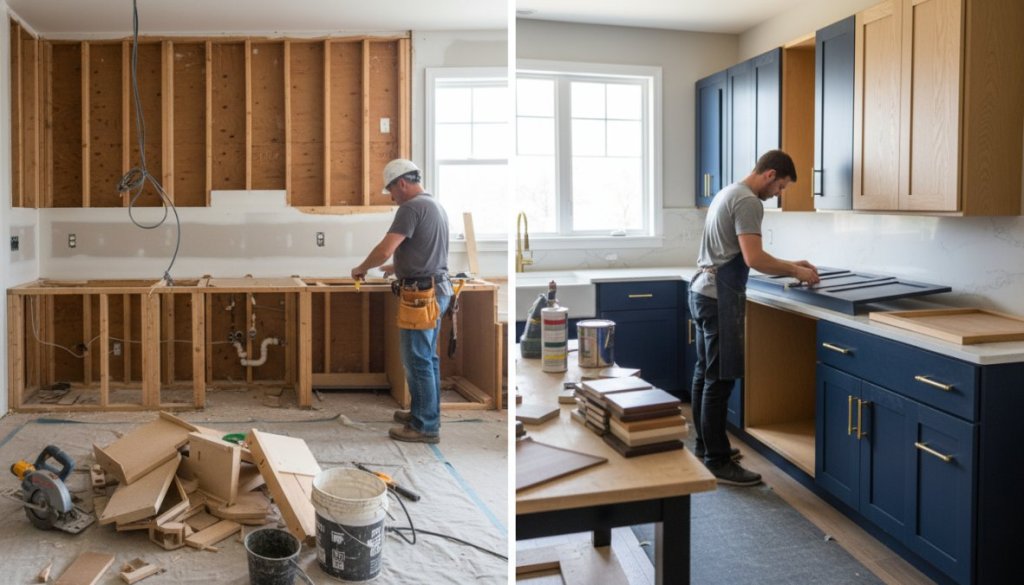
Cabinet refacing is the process of replacing cabinet doors, drawer fronts, and hardware while covering existing cabinet boxes with a matching veneer or laminate. The underlying cabinet framework stays in place. A full kitchen remodel, by contrast, involves removing and replacing cabinetry entirely, often alongside changes to the kitchen layout, plumbing, electrical, and flooring.
That distinction matters more than most homeowners realize. Refacing is a surface transformation. Remodeling is a structural one.
What Is Cabinet Refacing?
Cabinet refacing is a cosmetic renovation technique where new cabinet doors, drawer fronts, and end panels are installed over the existing cabinet boxes. The visible surfaces of the cabinet framework are covered with wood veneer, thermofoil, or laminate to match the new doors. Hardware including hinges, handles, and toe-kicks are replaced to complete the updated look.
Refacing works best when your cabinet boxes are structurally sound, your kitchen footprint is functional, and your primary goal is a visual change rather than a spatial one. Professional services like those offered through national retailers apply 1/4" plywood reinforcement to the existing cabinet framework before adding veneer, which adds longevity to the result.
What Is a Full Kitchen Remodel?
A full kitchen remodel involves removing existing cabinetry and replacing it with new custom cabinetry or semi-custom units. This process typically includes adjustments to the kitchen layout, new countertops, updated appliances, and changes to lighting or electrical. Because the cabinet boxes are replaced entirely, a remodel gives you the freedom to reconfigure storage, add an island, or shift to a modern European style that wouldn’t be possible through refacing alone.
The trade-off is time, disruption, and cost. A full remodel means your kitchen is out of service for weeks, not days.
Refacing vs Refinishing vs Resurfacing: Key Distinctions
These three terms are frequently confused, and conflating them leads to mismatched expectations.
- Refinishing means stripping and repainting or re-staining the existing cabinet doors and boxes. No new materials are added.
- Refacing means replacing cabinet doors and drawer fronts entirely and covering the cabinet boxes with new veneer or laminate.
- Resurfacing is often used interchangeably with refinishing but sometimes refers to applying a new laminate skin over existing surfaces without replacing doors.
Refinishing is the cheapest option and the least durable. Refacing delivers a more dramatic visual change. Remodeling is the only option if you need structural or layout changes.
Cabinet Refacing Pros and Cons Every Homeowner Should Know
Cabinet refacing occupies a specific and genuinely useful middle ground. It’s not the right choice for everyone, but for the right kitchen, it delivers impressive results at a fraction of the remodeling cost.
Pros of Cabinet Refacing
Cost savings. Refacing typically costs significantly less than full cabinet replacement because labor is reduced and no demolition is required. You’re paying for materials and installation, not for custom cabinetry lead times or structural work.
Faster turnaround. Most professional refacing projects complete in two to four days. Your kitchen is functional again quickly, with minimal project disruption to your household.
Less waste. Keeping the existing cabinet boxes out of a landfill is a meaningful environmental benefit that full remodels can’t match.
Predictable results. Because the cabinet framework stays in place, there are no surprises behind the walls. No hidden plumbing issues, no unexpected electrical runs.
Wide material options. Modern refacing materials include real wood veneer, thermofoil, laminate, and painted finishes, giving you access to styles from traditional to modern European without a full rebuild.
Cons of Cabinet Refacing
No layout changes. If you want to move a cabinet, add an island, or reconfigure the kitchen footprint, refacing won’t help. You’re locked into the existing kitchen layout.
Dependent on cabinet box condition. Refacing only works if the underlying cabinet boxes are structurally sound. Warped, water-damaged, or pest-compromised boxes cannot be refaced effectively.
Limited lifespan extension. Refacing breathes new visual life into a kitchen, but it doesn’t address aging drawer hardware, worn-out slides, or structural weaknesses in the cabinet framework.
Material compatibility constraints. Not all existing cabinet materials accept veneer adhesion equally well. Older laminate surfaces or particleboard boxes with significant swelling may not produce clean results.
Never proceed with refacing if your cabinet boxes show signs of water damage, mold, or significant structural weakness. Covering damaged boxes with new veneer doesn’t fix the underlying problem. It hides it until the damage gets worse.
Average Cost of Kitchen Remodel vs Cabinet Refacing Breakdown
Cost is where the two options diverge most sharply, and vague language like "significantly less" doesn’t help you build a realistic budget. Here is a grounded breakdown of what drives costs in each path, with ranges that reflect what most homeowners encounter in a mid-range U.S. market. Costs vary by region, kitchen size, and material tier, treat these as planning anchors, not quotes.
Cabinet Refacing Cost Breakdown
Professional cabinet refacing for a typical kitchen with 10 to 15 cabinet doors generally falls in the $3,500 to $9,000 range, with the spread driven by three variables:
- Door and drawer front material. Thermofoil and RTF (rigid thermofoil) doors sit at the lower end of the material cost range. Real wood veneer doors, particularly species like maple, cherry, or oak, push costs higher. Painted MDF doors fall in the middle.
- Veneer quality for the cabinet boxes. PSA (pressure-sensitive adhesive) veneer sheets are the most common professional choice. 10-mil paper-backed veneer is the budget option; 2-ply wood-on-wood veneer is more durable and more expensive.
- Hardware. Replacing hinges, pulls, and drawer slides across a full kitchen adds $200 to $800 depending on the hardware tier. Soft-close hinges and undermount drawer slides are the most common upgrade that adds meaningful cost.
A per-linear-foot estimate for professional refacing typically runs $200 to $500 per linear foot of cabinetry, inclusive of labor and materials. A 20-linear-foot kitchen at the midpoint of that range puts the total around $7,000.
Full Kitchen Remodel Cabinet Cost Breakdown
Cabinet replacement alone, not the full remodel, runs $5,000 to $25,000+ depending on whether you choose stock, semi-custom, or custom cabinetry:
| Cabinet Tier | Typical Cost Range (full kitchen) | Lead Time |
|---|---|---|
| Stock (big-box retail) | $5,000 – $10,000 installed | In stock or 1-2 weeks |
| Semi-custom | $10,000 – $18,000 installed | 4-8 weeks |
| Custom | $18,000 – $40,000+ installed | 8-16 weeks |
These figures cover cabinetry and installation only. A full kitchen remodel that includes countertops, appliances, flooring, and layout changes routinely reaches $30,000 to $80,000 in a mid-range market, with high-end renovations in major metros exceeding $100,000.
According to Remodeling Magazine’s Cost vs. Value Report, a major kitchen remodel has a national average cost that consistently places it among the top three most expensive home renovation projects tracked annually.
Hidden Costs of DIY vs Professional Installation
DIY refacing looks appealing on paper. Suppliers like CabinetNow, Barker Doors, and Walzcraft offer custom cabinet doors and PSA veneer sheets at per-item pricing that can cut material costs by 40 to 60 percent compared to a full professional service. But the true cost picture is more complicated.
Tool investment for a first-time DIY refacing project:
| Tool | Purchase Cost | Rental Cost (per day) |
|---|---|---|
| J-roller (veneer seam roller) | $15 – $30 | N/A (inexpensive to buy) |
| Contact cement (quart) | $20 – $35 | N/A (consumable) |
| Veneer trimmer / flush-trim router bit | $80 – $150 | $25 – $40 |
| Clamps (for door installation) | $40 – $80 | $15 – $25 |
| Hinge boring jig (for new hinge holes) | $30 – $60 | $15 – $20 |
| Brad nailer (for toe kicks and end panels) | $100 – $200 | $30 – $50 |
A homeowner who owns none of these tools faces a realistic tool outlay of $285 to $555 before purchasing a single door or sheet of veneer. For a one-time project, rentals reduce that to roughly $100 to $135 in tool costs, but rental logistics add time and complexity.
Labor hours for a DIY refacing project:
A professional two-person crew completes a typical kitchen refacing in 16 to 24 total labor hours (two to three days on-site). A skilled DIYer working alone should budget:
- Surface prep and cleaning: 3 to 5 hours
- Veneer application to cabinet boxes: 6 to 12 hours (the most skill-dependent step)
- Door and drawer front installation: 4 to 8 hours
- Hardware installation and adjustment: 2 to 4 hours
- Toe kicks, end panels, and finishing: 2 to 4 hours
Total: 17 to 33 hours for a first-time DIYer, spread across multiple weekends. That’s two to four weeks of kitchen disruption versus two to four days for a professional crew.
The mistake cost. Veneer application is the step where DIY projects most often go wrong. Bubbles, misaligned seams, and adhesion failures on the first attempt mean wasted veneer sheets. PSA veneer typically costs $3 to $8 per square foot; a botched application on even a few cabinet faces adds $50 to $200 in wasted material. Contact cement applications are even less forgiving, once two contact-cemented surfaces touch, repositioning is nearly impossible without damaging the substrate.
If you’re going the DIY route, order one extra door and a test strip of veneer before committing to the full order. Apply the veneer to a scrap piece of your actual cabinet box material, not a piece of new plywood, to test adhesion. Older laminate over particleboard, a common substrate in kitchens built before 2000, behaves very differently under contact cement than raw wood or plywood does.
The honest DIY math: On a 15-door kitchen, a homeowner who sources doors and veneer from a direct supplier, owns most of the tools, and executes the project without significant mistakes can realistically spend $1,800 to $3,500 in materials, saving $3,000 to $5,000 versus professional installation. That savings comes at the cost of 20 to 30 hours of skilled labor and several weeks of kitchen downtime. Whether that trade is worthwhile depends entirely on your skill level, your schedule, and your tolerance for a project that has a steep learning curve on the first attempt.
How Long Does Cabinet Refacing Take Compared to a Full Remodel?
How long does cabinet refacing take? For most kitchens, professional refacing takes two to four days from start to finish. DIY projects typically run one to three weeks depending on skill level and available time.
A full kitchen remodel operates on an entirely different timeline. Depending on scope, expect four to twelve weeks from demolition to completion. Custom cabinetry lead times alone can add several weeks before installation even begins. Layout changes involving plumbing or electrical work extend the timeline further.
The practical implication: refacing means your kitchen is functional again within a week. A remodel means weeks of eating takeout and washing dishes in the bathroom sink.
For homeowners who can’t tolerate extended kitchen downtime, cabinet refacing’s turnaround time is one of its strongest arguments.
Signs You Need a Full Kitchen Remodel Instead of Refacing
The biggest mistake homeowners make is choosing refacing when their kitchen actually needs a full remodel. The signs are usually visible if you know what to look for.
Structural Integrity Assessment Checklist
Before committing to refacing, assess your cabinet boxes against this checklist. If you check more than two items in the "remodel" column, refacing is the wrong choice.
Your cabinets are refacing candidates if:
- Cabinet boxes are solid wood or quality plywood with no warping
- Drawer slides operate smoothly or need only minor adjustment
- No visible water stains, mold, or soft spots inside the cabinet boxes
- The kitchen layout functions well for your household
- Cabinet doors close evenly and the frames are square
- No pest damage or infestation history in the cabinet framework
Your kitchen needs a full remodel if:
- Cabinet boxes show warping, swelling, or delamination
- Water damage is visible inside cabinets, particularly under the sink
- The kitchen layout no longer suits your household’s needs
- You want to move walls, add an island, or significantly change the kitchen footprint
- Drawer slides are broken or the cabinet framework is structurally compromised
- Mold or pest damage is present inside the cabinet boxes
A common mistake is underestimating water damage under the kitchen sink. Pull everything out and press firmly on the cabinet floor. If it flexes or feels soft, the particleboard has absorbed moisture and the structural integrity is compromised. Refacing that box is a short-term fix with a long-term problem underneath.
According to the National Kitchen and Bath Association’s renovation guidelines, proper assessment of existing cabinet condition is a foundational step before any kitchen renovation decision.
Kitchen Remodel vs Cabinet Refacing: Side-by-Side Comparison
| Factor | Cabinet Refacing | Full Kitchen Remodel |
|---|---|---|
| Typical timeline | 2-4 days (professional) | 4-12 weeks |
| Layout changes possible | No | Yes |
| Cabinet boxes replaced | No | Yes |
| Cost level | Lower | Higher |
| Kitchen downtime | Minimal | Significant |
| Best for | Sound boxes, cosmetic update | Damaged boxes, layout changes |
| Material options | Veneer, thermofoil, laminate | Custom, semi-custom cabinetry |
| ROI at resale | Moderate | Higher (major remodel) |
| DIY-friendly | Moderately | Rarely |
| Structural issues addressed | No | Yes |
Material Compatibility Guide for Refacing
Not all existing cabinets accept refacing materials equally. Here’s how common cabinet materials perform as refacing substrates:
Solid wood boxes: Excellent adhesion for veneer and laminate. Best substrate for refacing. Hinge replacement is straightforward.
Plywood boxes: Very good adhesion. Plywood holds screws well for new hardware and accepts contact cement reliably. A strong refacing candidate.
MDF (medium-density fiberboard): Good adhesion on flat surfaces, but MDF is vulnerable to moisture. Inspect carefully for any swelling before proceeding.
Particleboard boxes: Acceptable if dry and undamaged. Particleboard that has absorbed moisture swells and loses structural integrity. Screws don’t hold well in swollen particleboard, which affects hinge replacement quality.
Existing laminate over particleboard: The trickiest substrate. New veneer over old laminate requires thorough surface preparation and the right adhesive. A test section is strongly recommended before committing.
The material compatibility of your existing cabinet boxes is the single most important technical factor in determining whether refacing will produce professional-quality results. Don’t skip the substrate assessment.
Resale Value and ROI: Which Option Pays Off More?
The ROI question is where homeowners receive the most misleading guidance. Most articles cite a single national average and call it done. The honest answer requires understanding how appraisers and buyers actually value kitchen updates, and that mechanism differs meaningfully between refacing and remodeling.
How Appraisers Value Kitchen Updates
Residential appraisers do not assign a fixed dollar value to a kitchen remodel or a cabinet refacing project. Instead, they use a contributory value framework: the upgrade is worth whatever it contributes to the home’s market value relative to comparable sales in the same neighborhood, not what it cost to complete.
This distinction matters enormously. A $40,000 full kitchen remodel in a neighborhood where comparable homes sell for $280,000 may contribute only $8,000 to $15,000 in appraised value, because buyers in that price range have a ceiling on what they’ll pay for kitchen finishes, regardless of quality. The same $40,000 remodel in a neighborhood where comparables sell for $750,000 may contribute $30,000 to $45,000, because the buyer pool expects and will pay for high-end finishes.
Cabinet refacing operates differently in this framework. Because the investment is lower, the risk of over-improving relative to the neighborhood is much smaller. A $7,000 refacing project that makes a kitchen look current and clean is unlikely to be "over-improvement" in almost any market, it simply removes a negative (dated, visually tired kitchen) without creating a cost-recovery problem.
Regional Patterns in Kitchen Renovation ROI
According to Remodeling Magazine’s Cost vs. Value Report, which tracks renovation ROI across nine U.S. regions annually, kitchen renovation cost recovery varies significantly by geography. A few patterns that hold consistently across recent editions:
- Pacific and Mid-Atlantic markets (Seattle, San Francisco, New York metro, Washington D.C.) tend to show stronger cost recovery on major kitchen remodels because home price points are high enough to support premium finishes without hitting a contributory value ceiling.
- South Central and East South Central markets (Texas, Oklahoma, Alabama, Mississippi) tend to show weaker cost recovery on major remodels, where the gap between remodel cost and contributory value is often widest.
- Minor kitchen remodels, defined in the Cost vs. Value methodology as a cosmetic update that preserves the existing layout, consistently outperform major remodels on percentage cost recovery nationally. Cabinet refacing falls squarely in the "minor remodel" category by this definition.
The National Association of Realtors’ Remodeling Impact Report NAR Remodeling Impact Report tracks buyer appeal alongside cost recovery, and kitchen projects consistently rank among the top renovations for attracting buyer interest, but "attracting interest" and "recovering cost" are not the same metric. Refacing scores well on the first; full remodels score better on the second only when the home’s price point supports it.
The Listing Speed Advantage: ROI That Doesn’t Show Up in Appraisals
Most ROI analyses focus exclusively on appraised value or sale price. They miss a financially significant variable: days on market.
A kitchen that looks dated is one of the most commonly cited reasons buyers pass on a showing or submit a lowball offer. A refacing project that costs $6,000 to $8,000 and takes four days to complete can meaningfully improve how a kitchen photographs for online listings, which is where most buyers form their first impression before ever scheduling a showing.
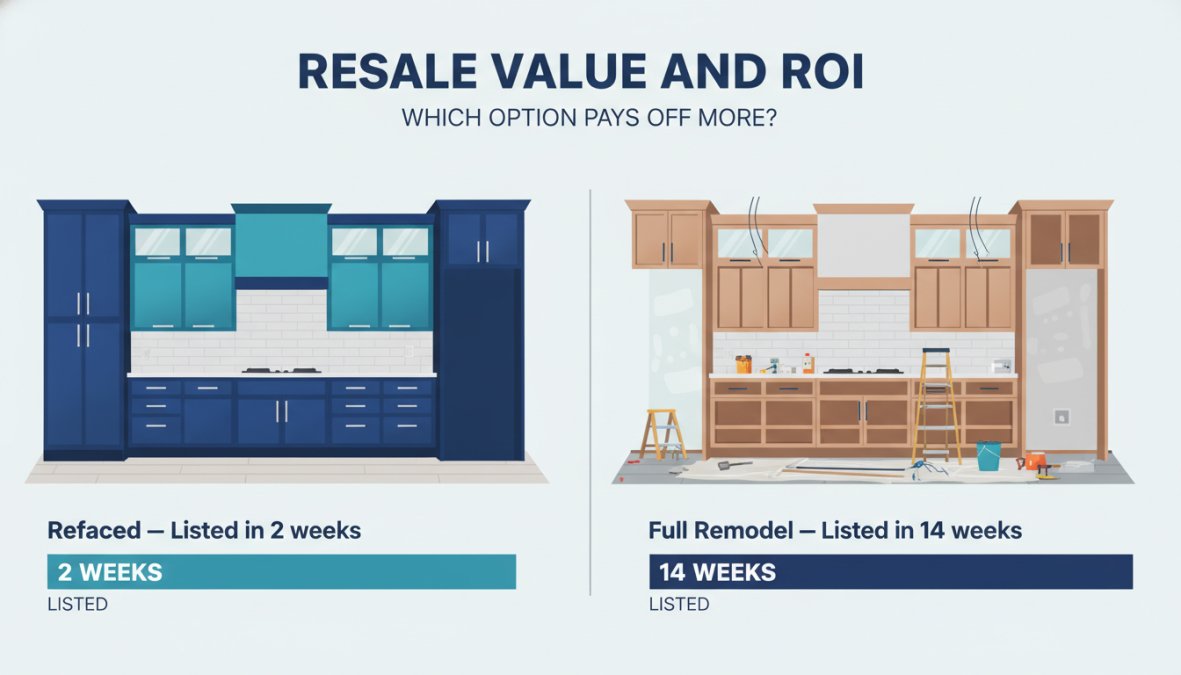
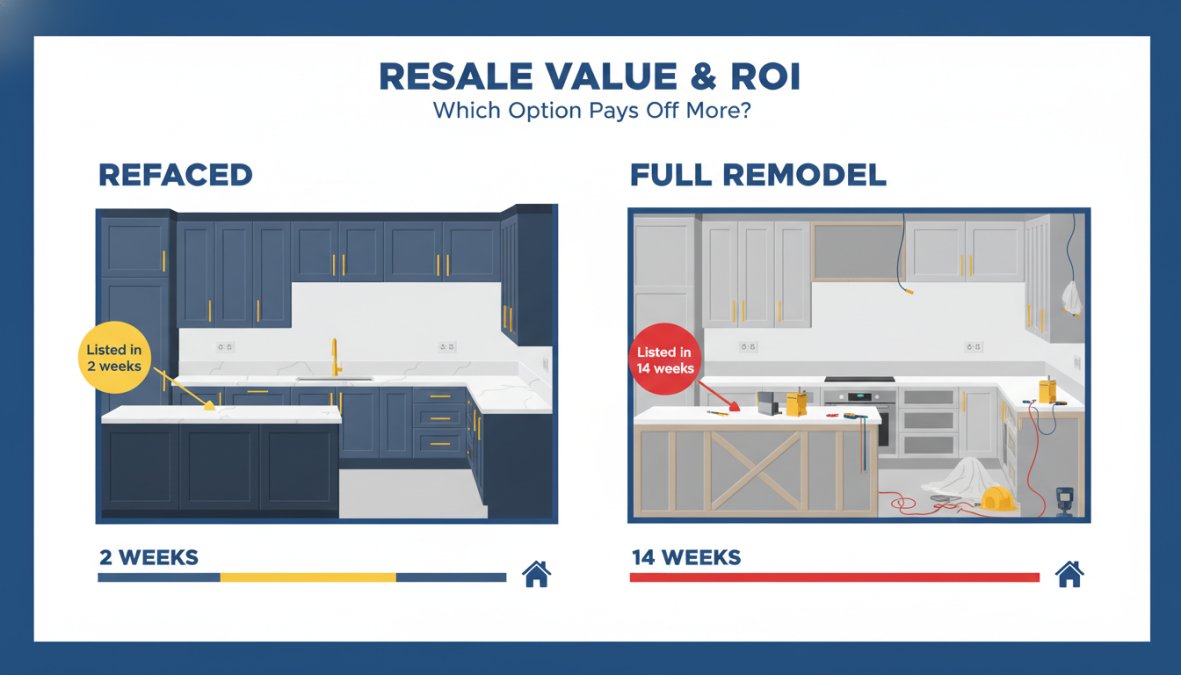
In a market where carrying costs (mortgage, taxes, insurance, utilities) run $2,500 to $4,000 per month, reducing days on market by even three to four weeks has a direct financial value of $1,875 to $4,000. That return doesn’t appear in any appraisal report, but it’s real money that refacing can generate in a way that a months-long full remodel cannot, because the remodel delays the listing date entirely.
A Practical ROI Framework by Scenario
Rather than a single national figure, use this decision framework:
Scenario 1: Selling within 12 months, mid-range market
Refacing is almost always the better financial decision. The lower investment, faster completion, and listing-speed benefit combine to deliver strong net return without the risk of over-improvement.
Scenario 2: Selling within 12 months, high-value market (home price above $600K)
A full remodel may be justified if the kitchen is genuinely dysfunctional or severely dated relative to comparable listings. Buyers at this price point have high expectations and will discount aggressively for a kitchen that feels out of step with the home’s overall quality. Get a pre-listing consultation with a local real estate agent who can pull specific comparable sales data before committing.
Scenario 3: Staying in the home 5 or more years
ROI at resale becomes less important than livability and durability. A full remodel that improves layout, storage, and functionality delivers daily quality-of-life value that refacing cannot. The resale question becomes secondary to whether the kitchen actually works for your household.
Scenario 4: Investment property or rental
Refacing almost always wins. Tenants and rental market buyers respond to clean, updated appearances, not custom cabinetry. The lower cost and faster turnaround maximize the time the property is generating income rather than sitting under renovation.
The single most useful thing you can do before making an ROI-based decision is ask a local real estate agent to pull three to five recent comparable sales in your specific neighborhood, not your city, your neighborhood, and identify whether the kitchens in those comps were updated. That data tells you what your actual buyer pool will pay for a kitchen upgrade far more accurately than any national average.
Frequently Asked Questions
Is cabinet refacing cheaper than a full kitchen remodel?
Generally, yes. Cabinet refacing typically costs a fraction of a full kitchen remodel because you keep the existing cabinet framework and only replace cabinet doors, drawer fronts, and apply new veneer or laminate to the cabinet boxes. A full kitchen remodel involves new custom cabinetry, labor costs for demolition, and often changes to plumbing or the kitchen layout, all of which significantly increase the total investment. Refacing is the more budget-friendly option when your cabinet boxes are structurally sound.
What are the pros and cons of cabinet refacing?
Cabinet refacing pros include lower cost than full replacement, shorter turnaround time, less project disruption, and a refreshed appearance without changing the kitchen footprint. Cons include the inability to change your kitchen layout, limitations if cabinet boxes are damaged or warped, and material compatibility issues with older cabinetry. Thermofoil, veneer, and laminate each have different durability profiles. Refacing also won't fix poor storage design or outdated plumbing and electrical systems hidden behind the cabinetry.
How long does cabinet refacing take compared to a full kitchen remodel?
Cabinet refacing typically takes two to five days for a professional contractor to complete, making it one of the fastest kitchen update options available. A full kitchen remodel, by contrast, can take anywhere from three to eight weeks or longer depending on scope, custom cabinetry lead times, and the complexity of layout changes. If minimizing down time and project disruption is a priority, especially in a primary kitchen, refacing offers a significantly faster path to a refreshed space.
When should you choose a full kitchen remodel over refacing?
Choose a full kitchen remodel when your cabinet boxes show signs of structural damage such as warping, water damage, or pest intrusion. You should also opt for full replacement if you want to change your kitchen layout, add modern European style cabinetry, improve storage configuration, or update plumbing and electrical systems. If your drab cabinetry is beyond a cosmetic fix, or if you're planning to sell and want maximum ROI from a complete kitchen facelift, a full remodel is the stronger long-term investment.
Does cabinet refacing increase home value?
Cabinet refacing can improve a home's perceived value and appeal to buyers by giving worn-out cabinetry a fresh, modern look at a lower cost than full replacement. While resale value impact varies by region and local market conditions, an updated kitchen generally supports faster sales and stronger offers. However, if the underlying cabinet framework is visibly dated or the kitchen layout is inefficient, buyers may still factor in the cost of a full remodel, making structural improvements the better investment in those cases.
Can you change your kitchen layout with cabinet refacing?
No, cabinet refacing preserves your existing kitchen footprint and cabinet framework, so it does not allow for layout changes. If you want to move the sink, add an island, reconfigure storage, or open up the space, you'll need a full kitchen remodel. Refacing is strictly a cosmetic update: new cabinet doors, drawer fronts, hardware, veneer, and end panels are applied to the existing structure. For homeowners happy with their current layout but wanting a visual change, refacing delivers that efficiently.
This article was written using GrandRanker
 Tony's Home Improvement LLC
Leave a comment