Table of Contents
- What Residential Remodeling Services in Fairfield County Actually Cover
- Kitchen Remodeling Costs in Fairfield CT: What to Budget
- Design-Build Firms in Fairfield County: Top Options Compared
- Fairfield County Building Permits Guide for Remodeling Projects
- Home Addition Contractors in Fairfield CT: How to Find and Hire the Best
- DIY vs. Professional Repair: A Decision Matrix for Fairfield County Homeowners
- Government Grants, Repair Loans, and Income-Based Assistance Programs
- How to Choose the Right Residential Remodeling Services in Fairfield County
- Conclusion
Last Updated: May 14, 2026
Fairfield County homeowners spent more on home renovation last year than at any point in the past decade, and the demand for residential remodeling services Fairfield county continues to outpace the supply of qualified contractors. Tony’s Home Improvement LLC has helped dozens of local homeowners cut through the noise, and this guide distills everything you need to make smart decisions about your next project. Below, we cover costs, permits, contractor selection, government assistance programs, and a decision matrix most guides never bother to include. Read to the end before signing any contract.
What Residential Remodeling Services in Fairfield County Actually Cover
Residential remodeling services in Fairfield County cover a broader scope than most homeowners initially expect. The category spans everything from minor cosmetic updates to full structural transformations, and understanding where your project falls on that spectrum determines your budget, timeline, and contractor requirements.
Home Improvement vs. Home Renovation: Knowing the Difference
Home improvement is the practice of updating or upgrading existing systems and finishes without altering the structural footprint of a home. Think new flooring, fresh paint, updated fixtures, or a bathroom refresh.
Home renovation goes further. It involves changing the structure, layout, or function of a space, such as removing a load-bearing wall, adding a room, or converting a basement into living space. Renovation typically requires building permits in Connecticut, while many improvement projects do not.
The distinction matters because it affects your contractor selection, budget, and timeline. Hiring a handyman for a job that requires a licensed general contractor is one of the most common and costly mistakes Fairfield County homeowners make.
Most Popular Projects Among Fairfield County Homeowners
Local contractors report consistent demand for the following project types:
- Kitchen remodels (full and partial)
- Bathroom renovations
- Basement finishing and waterproofing
- Home additions and second-story builds
- Deck construction and outdoor living spaces
- Roofing replacement and repair
- HVAC upgrades and energy efficiency retrofits
- Accessibility modifications for aging-in-place
- Interior and exterior painting
- Hardwood floor installation and refinishing
The Fairfield County housing stock skews older, with many homes built between 1940 and 1980. That means structural repairs, plumbing repair, and electrical updates frequently surface during what homeowners initially plan as cosmetic projects. Budget a contingency of at least 15-20% for any project in a home older than 40 years.
Skipping the contingency budget is the single most common reason Fairfield County renovation projects stall mid-construction. Older homes routinely reveal hidden issues once walls open, and a contractor who discovers outdated knob-and-tube wiring cannot legally leave it in place.
Kitchen Remodeling Costs in Fairfield CT: What to Budget
Kitchen remodeling costs in Fairfield CT vary significantly based on scope, material selections, and whether structural changes are involved. Fairfield County sits in one of the highest labor-cost markets in New England, which means national cost averages published by platforms like Angi or HomeAdvisor routinely underestimate what local homeowners actually pay. The framework below is built from the cost structures local contractors and industry organizations consistently describe for this market.
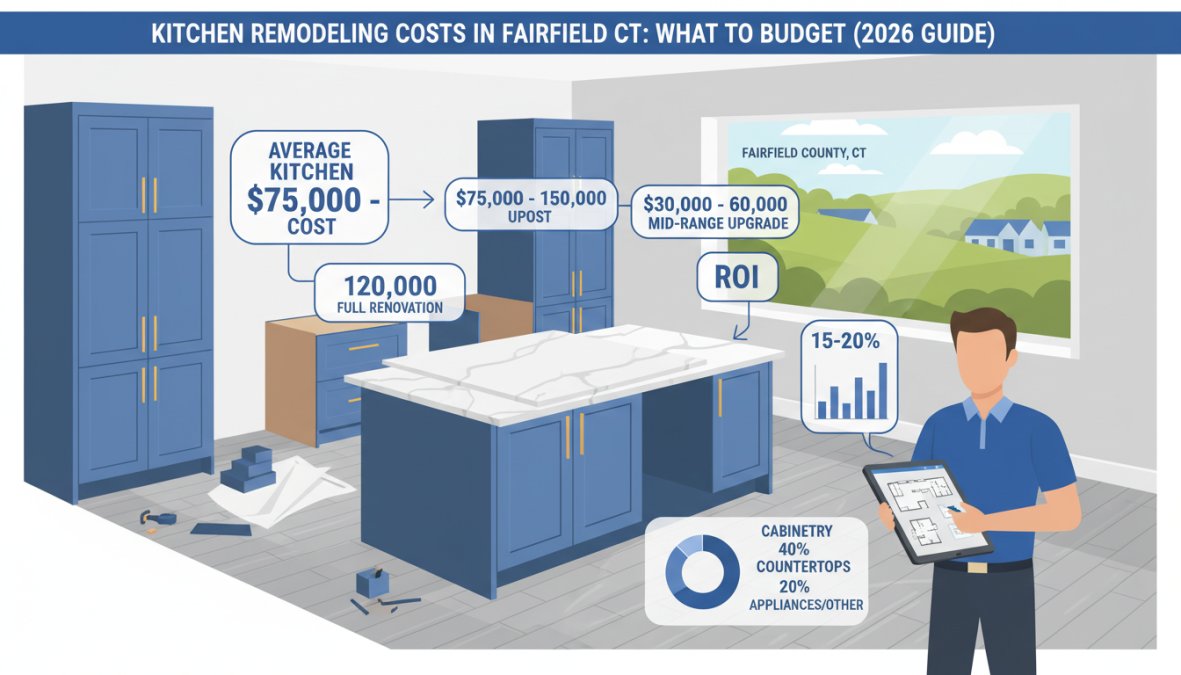
A contractor reviewing updated cabinetry plans on a tablet while standing beside newly installed white shaker cabinets and a quartz countertop in a bright, sunlit Fairfield County kitchen.
Cost Breakdown by Project Scope
| Scope | What’s Included | Typical Cost Range (Fairfield County) |
|---|---|---|
| Minor Refresh | New hardware, paint, appliances, lighting | $8,000 – $20,000 |
| Mid-Range Remodel | Semi-custom cabinets, new countertops, tile backsplash, updated fixtures | $40,000 – $75,000 |
| Full Custom Renovation | Layout changes, custom cabinetry, premium stone, high-end appliances | $90,000 – $150,000+ |
| Structural Addition | Expanding kitchen footprint, new windows, doors, or load-bearing changes | $150,000 – $250,000+ |
These ranges reflect Fairfield County’s premium labor market and should be treated as planning anchors, not guarantees. Material costs for cabinetry and stone have been volatile since 2022. Always collect three itemized written quotes before finalizing a budget.
What Drives Costs Up Fastest in Fairfield County
Several cost drivers are specific to this market and routinely surprise homeowners who budgeted using national averages:
1. Custom cabinetry from local mill shops. Many Fairfield County homeowners in the $700K-$2M home segment choose semi-custom or fully custom cabinetry. The jump from stock to semi-custom can add $15,000-$30,000 to a mid-range project. The jump from semi-custom to fully custom can double that.
2. Structural surprises in older homes. The county’s housing stock skews heavily toward homes built between 1940 and 1980. Opening walls for a layout change frequently reveals knob-and-tube wiring, undersized drain lines, or inadequate subfloor structure. Budget a contingency of 15-20% for any home over 40 years old, not as a cushion, but as an expected line item.
3. Permit and inspection fees. Greenwich, Westport, Darien, and Fairfield each have their own building departments with different fee schedules. Permit costs for a full kitchen renovation typically run $500-$2,500 depending on the municipality and project scope. These fees are non-negotiable and should appear as a line item in every contractor quote.
4. Asbestos and lead abatement. Homes built before 1978 may contain lead paint in walls and cabinets, and homes built before 1986 may have asbestos in floor tiles or pipe insulation. If testing reveals either, licensed abatement is legally required before demolition proceeds. Abatement costs vary widely by scope but can add $3,000-$15,000 to a project budget.
5. Appliance lead times. Premium appliance brands popular in Fairfield County, Sub-Zero, Wolf, Miele, have carried lead times of 8-20 weeks in recent years. A contractor who does not account for appliance delivery in the project schedule will leave you with a finished kitchen you cannot use.
The Real Cost of the Lowest Bid
Fairfield County homeowners frequently report that the lowest bid on a kitchen project ends up costing more than the middle bid would have. The pattern is consistent: a low-bid contractor wins the job, encounters the structural surprises that an experienced local contractor would have anticipated and priced in, and then issues change orders that erode the original savings.
The most reliable way to compare bids is to require itemized quotes, labor, materials, permits, demolition, debris removal, and a stated contingency allowance, and then compare line by line. A contractor who refuses to provide an itemized quote is telling you something important.
How to Get Accurate Project Quotes from Local Pros
Getting accurate project quotes is a process, not a phone call. Follow these steps:
- Prepare a written scope of work before contacting any contractor
- Specify your material preferences (stock, semi-custom, or custom cabinets; laminate vs. stone countertops)
- Request itemized quotes, not lump-sum figures
- Ask each contractor to identify potential hidden costs specific to your home
- Verify that each quote includes permit fees, demolition, and debris removal
- Ask explicitly: "Does this quote include a contingency allowance, and if not, what is your process when unexpected conditions arise?"
- Compare line items, not totals
According to the National Association of the Remodeling Industry’s project guidance, homeowners who prepare detailed project scopes before soliciting bids receive more accurate and comparable quotes than those who describe projects verbally.
Ask every contractor: “What have you found inside walls in similar homes in this neighborhood?” A contractor who has worked extensively in Fairfield County will have specific, concrete answers about knob-and-tube wiring, galvanized plumbing, or asbestos tile. Vague responses are a red flag. Specific answers, even uncomfortable ones, are a sign of experience you can trust.
Design-Build Firms in Fairfield County: Top Options Compared
The design-build model consolidates architecture, design, and construction under one contract. For complex projects, this eliminates the coordination friction between a separate architect and general contractor. Here are the strongest local options.
| Firm | Specialty | Best For | Notable Feature |
|---|---|---|---|
| Tony’s Home Improvement LLC | Full residential and commercial remodeling | All project sizes, cost-effective solutions | Economical material sourcing, meticulous detail |
| Stephen Gidley Inc. | Colonial restorations, outdoor living | Large-scale or historic renovations | 54 years of experience, 15,000+ projects |
| Raymond Design Builders | Custom interiors, additions | Clients wanting bespoke cabinetry | In-house cabinet and mill shop |
| Remodeling Consultants | Stress-free full-service renovations | Busy professionals | 58+ years serving Fairfield and Westchester |
| Buttendorf Building LLC | General residential contracting | Owner-involved family-run projects | Four generations of local experience |
Tony’s Home Improvement LLC stands out for homeowners who need both cost-effective solutions and meticulous attention to detail across many project sizes. The firm’s economical sourcing of materials keeps budgets realistic without sacrificing quality, and clear communication throughout the project prevents the scope creep that plagues many Fairfield County renovations.
General Contractor vs. Design-Build Firm: Which Is Right for You?
A general contractor manages construction and subcontractors but typically does not provide design services. You supply the plans; they execute them. A design-build firm handles both, which reduces miscommunication but means a single firm controls your entire budget.
Choose a general contractor when you already have architectural drawings and want competitive bidding on construction. Choose a design-build firm when you want one point of accountability from concept through completion, or when your project involves significant design decisions.
For most Fairfield County homeowners undertaking kitchen remodels, additions, or full-home renovations, the design-build model saves time and reduces the risk of design-to-construction translation errors.
Fairfield County Building Permits Guide for Remodeling Projects
Permits are not optional, and the Fairfield County building permits process is not as painful as many homeowners fear. The real risk is skipping it. Unpermitted work can invalidate your homeowner’s insurance, complicate a future home sale, and require costly demolition and rebuilding to bring the home into compliance.
Which Projects Require a Permit in Connecticut
According to Connecticut’s State Building Code guidelines, permits are generally required for:
- Structural additions and alterations
- Electrical work beyond simple fixture replacement
- Plumbing changes that involve new or relocated lines
- HVAC system installation or replacement
- Roofing replacement (in most municipalities)
- Basement finishing that adds habitable square footage
- Deck construction above a certain height or square footage
Cosmetic work, such as painting, flooring replacement, and cabinet refacing, typically does not require a permit. When in doubt, call your town’s building department directly. Fairfield, Westport, Greenwich, Norwalk, and Bridgeport each have their own building departments with slightly different thresholds.
How to Navigate the Permit Process Without Delays
The most common cause of permit delays is incomplete documentation. Most Fairfield County building departments require:
- A completed permit application
- Site plan or plot plan showing the home’s footprint
- Construction drawings (required for structural work)
- Contractor license and insurance documentation
- Homeowner authorization if the contractor is applying on your behalf
Many established contractors, including Fairfield County Services LLC, handle permit procurement and inspection management as part of their service. If your contractor expects you to pull your own permits, ask why. A licensed contractor should be comfortable managing this process.
Permit timelines in Fairfield County towns typically run two to six weeks for residential projects. Build this into your project schedule from day one. Starting demolition before permit approval is a common mistake that results in stop-work orders and fines.
Home Addition Contractors in Fairfield CT: How to Find and Hire the Best
Finding home addition contractors in Fairfield CT requires more due diligence than hiring for a cosmetic project. Additions involve structural engineering, foundation work, and integration with existing systems, and the margin for error is narrow.
Start your search by asking for referrals from neighbors who have completed similar projects. Fairfield County towns are geographically compact, and a contractor who has built a second-story addition in your neighborhood understands local soil conditions, zoning setbacks, and inspector preferences.
When evaluating candidates, verify:
- Connecticut Home Improvement Contractor (HIC) registration
- General liability insurance (minimum $1M per occurrence)
- Workers’ compensation coverage for all employees and subcontractors
- A physical business address (not just a P.O. box)
- References from projects completed within the past 24 months
Rowe Construction, based in Ridgefield, specializes in whole-home renovations and second-story additions with a focus on integrating new construction with the original home’s character. Harmony Design Build Contractors serves many Fairfield County towns and handles projects from small upgrades to full structural additions.
Structural Repairs and Accessibility Modifications to Consider
Home additions often surface the need for structural repairs that were previously invisible. Common issues include: undersized header beams, inadequate foundation drainage, and aging electrical panels that cannot support new square footage.
Accessibility modifications are increasingly requested alongside additions, particularly for multi-generational households. Consider incorporating:
- Wider doorways (36 inches minimum for wheelchair access)
- Zero-threshold shower entries
- Blocking in bathroom walls for future grab bar installation
- Single-floor living layouts that accommodate future mobility needs
Planning for accessibility during an addition costs far less than retrofitting later. As noted by the U.S. Department of Housing and Urban Development’s aging-in-place resources, proactive home modifications reduce long-term care costs and allow homeowners to remain in their homes longer.
DIY vs. Professional Repair: A Decision Matrix for Fairfield County Homeowners
Most guides either tell you to hire a pro for everything or celebrate DIY without acknowledging the real risks. Here is a more honest framework.
Use this matrix to decide:
| Task | DIY Viable? | Key Risk | Recommendation |
|---|---|---|---|
| Interior painting | Yes | Poor finish quality | DIY if patient |
| Tile replacement (small area) | Yes | Waterproofing errors | DIY with research |
| Drywall patching | Yes | Texture matching | DIY for small patches |
| Plumbing repair (fixture swap) | Sometimes | Code compliance | Pro if any pipe work |
| Electrical work | Rarely | Fire and code risk | Always hire a pro |
| Roofing | No | Fall risk, voided warranty | Always hire a pro |
| Structural modifications | No | Safety, permits | Always hire a pro |
| HVAC installation | No | Efficiency, warranty, code | Always hire a pro |
The real question is not "can I physically do this?" but "what is the cost of getting it wrong?" For anything involving electricity, gas, structure, or waterproofing, the cost of a DIY error routinely exceeds the cost of professional work from the start.
Emergency Repair Prioritization: What to Fix First
Emergency repairs demand a different decision framework. When something fails unexpectedly, prioritize in this order:
- Immediate safety threats: Gas leaks, electrical hazards, structural collapse risk. Call a licensed professional immediately. Do not attempt DIY.
- Active water intrusion: Roof leaks, burst pipes, and basement flooding cause exponential damage the longer they go unaddressed. Mitigate the water source first, then assess repair scope.
- HVAC failure in extreme weather: In Connecticut winters, a failed heating system becomes a habitability issue within hours.
- Compromised home security: Broken exterior doors, windows, or locks.
- Non-urgent but deteriorating conditions: Slow leaks, minor roof damage, peeling exterior paint. Schedule these within 30-90 days before they escalate.
Sustainable and Eco-Friendly Remodeling Materials Worth Considering
The market for sustainable remodeling materials has matured significantly. These options now compete on cost and aesthetics, not just environmental credentials:
- Reclaimed wood: Suitable for flooring, beams, and accent walls. Often stronger than new-growth lumber.
- Low-VOC paints and finishes: Standard practice among quality contractors. Reduces indoor air quality impact.
- Recycled content insulation: Cellulose insulation made from recycled paper performs comparably to fiberglass.
- Engineered hardwood: Uses less old-growth wood than solid hardwood with similar aesthetics.
- Energy Star-rated windows and doors: Directly reduces heating and cooling costs. Relevant for Connecticut’s climate.
Weatherization upgrades, including air sealing, insulation, and energy-efficient HVAC, often qualify for federal tax credits under the Inflation Reduction Act. Check the IRS Energy Efficient Home Improvement Credit guidance for current eligibility requirements before budgeting your project.
Government Grants, Repair Loans, and Income-Based Assistance Programs
Not every Fairfield County homeowner pays out-of-pocket for home repairs. Several programs exist for income-qualified residents, veterans, seniors, and rural homeowners, and they are dramatically underutilized because most homeowners assume they will not qualify. The eligibility thresholds are broader than most people expect, particularly for energy efficiency and accessibility programs. A single housing counseling session can identify thousands of dollars in available assistance that a homeowner would otherwise leave on the table.
This section covers the programs most relevant to Fairfield County residents, what each actually provides, who qualifies, and how to apply, not just that they exist.
Connecticut Housing Finance Authority (CHFA) Home Improvement Programs
What it provides: CHFA administers several loan products for Connecticut homeowners, including the Home of Your Own program and emergency repair loan options. These are below-market-rate loans, not grants, but the interest rates and terms are structured to be accessible to moderate-income households.
Who qualifies: Income limits vary by household size and program. CHFA programs are generally available to homeowners whose income falls at or below 80% of the Area Median Income (AMI) for their county, though some programs extend to 120% AMI. Fairfield County’s AMI is among the highest in Connecticut, which means the dollar thresholds are higher than in other parts of the state, more households qualify than assume they do.
How to apply: Applications are processed through CHFA-approved lenders, not directly through CHFA. The first step is contacting a HUD-approved housing counselor (see below) who can match you to the right product and help you prepare the application. Find current program details at the Connecticut Housing Finance Authority’s homeowner resources.
HUD-Approved Housing Counseling: The Starting Point Most Homeowners Skip
Before applying to any program, a session with a HUD-approved housing counselor is the highest-leverage hour you can spend. These counselors are trained to identify every program a household qualifies for, including programs the homeowner has never heard of, and to help navigate the application process.
Housing counseling is free or low-cost. Sessions typically run 60-90 minutes. The counselor reviews your income, home condition, and repair needs, then maps available assistance across federal, state, utility, and local programs.
Find a HUD-approved agency serving Fairfield County through HUD’s housing counselor locator. NeighborWorks New Horizons, based in Bridgeport, is one of the HUD-approved agencies serving Fairfield County residents and has specific expertise in repair loan navigation.
Bring documentation to your housing counseling session: your most recent tax return, a current mortgage statement, proof of homeowner’s insurance, and a written list of the repairs you need. The more specific your repair list, the more precisely the counselor can match you to available programs.
USDA Section 504 Home Repair Program
What it provides: This federal program offers both loans (up to $40,000) and grants (up to $10,000, or up to $27,500 when combined with a loan) for very low-income homeowners. Grants are specifically available to homeowners aged 62 and older and must be used to remove health and safety hazards, not cosmetic improvements.
Who qualifies: Applicants must own and occupy the home, be unable to obtain affordable credit elsewhere, and have household income below 50% of the area median income. The property must be in an eligible rural area.
Fairfield County eligibility note: Most of Fairfield County’s denser municipalities, Bridgeport, Norwalk, Stamford, do not qualify as rural under USDA definitions. However, some towns on the county’s northern and eastern fringe, including portions of Easton, Redding, and Weston, may qualify. Use the USDA’s property eligibility map to check a specific address before assuming ineligibility.
How to apply: Contact the USDA Rural Development Connecticut State Office directly. Applications are processed through local USDA offices, and waitlists exist in some areas, applying early matters.
Connecticut Energy Efficiency Programs: Weatherization and HVAC
Weatherization and energy efficiency upgrades represent the largest pool of available assistance for Fairfield County homeowners who do not qualify for income-based repair programs. These programs are administered through Connecticut’s electric and gas utilities and are available across a wider income range than most repair programs.
Eversource and United Illuminating programs: Both utilities administer the Connecticut Energy Efficiency Fund, which subsidizes insulation, air sealing, heating system upgrades, and weatherization for residential customers. Income-eligible customers can receive these services at no cost. Moderate-income customers receive subsidized rates. Market-rate customers receive rebates.
How to access: Call your utility provider directly or visit Energize Connecticut’s home energy solutions program. An energy auditor will assess your home and identify qualifying upgrades. The audit itself is typically free or heavily subsidized.
Federal Inflation Reduction Act tax credits: Weatherization upgrades, including insulation, air sealing, energy-efficient windows and doors, and heat pump installation, may qualify for federal tax credits under the Energy Efficient Home Improvement Credit (25C). The credit covers up to 30% of qualifying costs, with annual caps that vary by upgrade type. Check the IRS Energy Efficient Home Improvement Credit guidance for current eligibility requirements before budgeting your project. These credits can be stacked with utility rebates, which is a combination most homeowners do not realize is permitted.
Veterans Assistance: SAH and SHA Grants
What it provides: The VA’s Specially Adapted Housing (SAH) grant and Special Housing Adaptation (SHA) grant fund accessibility modifications for eligible veterans with service-connected disabilities. SAH grants can fund modifications up to a substantial dollar threshold (amounts are adjusted periodically by Congress, verify current limits at va.gov). SHA grants cover a lower threshold and are designed for veterans who are adapting a home they or a family member owns.
Who qualifies: Veterans with specific service-connected disabilities affecting mobility. Eligibility is determined by the VA, not by the contractor or housing counselor.
How to apply: Apply through your regional VA office or through the VA’s Specially Adapted Housing program. A VA-approved appraiser will assess the home and the veteran’s specific needs before grant approval.
How to Stack Multiple Programs: A Practical Sequence
The most financially sophisticated approach to home repair assistance is stacking programs, using multiple sources to cover different aspects of the same project. A common pattern for income-eligible Fairfield County homeowners:
- Start with a HUD housing counseling session to map all available programs.
- Apply for utility weatherization programs first, these have the shortest approval timelines and can be completed independently of other programs.
- Apply for CHFA or USDA repair loans for structural or safety repairs that weatherization does not cover.
- Claim IRA tax credits for any energy efficiency upgrades completed during the same tax year, even if those upgrades were partially funded by utility rebates.
- Apply for VA grants if applicable, these are processed separately and do not affect eligibility for other programs.
Program availability, income limits, and funding levels change annually. The information above reflects program structures as of the article’s last update date, but specific dollar amounts and eligibility thresholds should be verified directly with each program before applying. A HUD-approved housing counselor will always have the most current information for your specific situation.
Income-based services and repair loans are underutilized because many homeowners assume they do not qualify. The eligibility thresholds are broader than most people expect, particularly for energy efficiency and accessibility programs. A housing counseling session typically takes less than an hour and can identify thousands of dollars in available assistance.
How to Choose the Right Residential Remodeling Services in Fairfield County
Choosing the right residential remodeling services in Fairfield county comes down to matching contractor capabilities to your specific project scope. A firm with deep expertise in historic Colonial restorations is not necessarily the right choice for a modern open-concept kitchen addition, and vice versa.
A practical checklist for contractor evaluation:
- Verify Connecticut HIC registration at the Department of Consumer Protection
- Confirm general liability and workers’ compensation insurance
- Request and check a minimum of three references from completed projects
- Review online reviews across multiple platforms (Google, Houzz, BBB)
- Confirm the contractor pulls permits, not the homeowner
- Get a written contract with payment schedule tied to project milestones
- Clarify who supervises the job site daily
- Confirm the warranty on both labor and materials
Valley Home Renovations LLC offers financing options for qualified projects, which is genuinely rare among local contractors and worth noting for homeowners managing cash flow. For homeowners who want a fully managed, hands-off experience, Remodeling Consultants has built its entire model around stress-free project delivery.
Red Flags to Watch for When Reviewing Contractors
The Fairfield County market includes excellent contractors and some who should be avoided. Watch for:
- Requests for large upfront payments: A deposit of 10-30% is standard. Requests for 50% or more before work begins are a warning sign.
- No physical business address: Legitimate contractors have a verifiable local presence.
- Pressure to decide immediately: Quality contractors have full schedules. Artificial urgency is a sales tactic, not a sign of high demand.
- Vague contracts: Every line item should be specified. "Kitchen remodel, $45,000" is not a contract.
- Unlicensed subcontractors: Ask whether subcontractors are licensed and insured independently.
- No permit discussion: Any contractor who suggests skipping permits to "save money" is putting your home and your finances at risk.
The Connecticut Department of Consumer Protection maintains a public database of licensed home improvement contractors. Checking it takes five minutes and eliminates a significant category of risk.
Hiring the wrong contractor for a Fairfield County renovation is an expensive mistake that takes months to unwind. Tony’s Home Improvement LLC brings cost-effective solutions, meticulous attention to detail, and clear communication to every project, whether you need a minor update or a major structural transformation. The firm’s economical sourcing of materials keeps projects on budget without compromising quality, and the commitment to a clean, professional work environment means your home stays livable throughout the process. Contact Tony’s Home Improvement LLC to discuss your project and get a clear picture of what your renovation will actually cost and take.
Frequently Asked Questions
How much does a home remodel cost in Fairfield County, CT?
Remodeling costs in Fairfield County vary widely by project scope. A minor kitchen refresh may start around $15,000-$25,000, while a full kitchen renovation can exceed $80,000. Bathroom remodels typically range from $10,000 to $40,000+. Home additions are among the most expensive projects, often starting at $100,000 depending on size and complexity. Always request itemized quotes from at least three local contractors to compare material sourcing, labor rates, and timelines before committing to a budget.
Do I need a building permit for residential remodeling in Fairfield County?
Most structural, electrical, plumbing, and HVAC work requires a permit in Fairfield County, CT. Projects like kitchen remodels, bathroom additions, home additions, roofing replacements, and basement finishing typically trigger permit requirements. Cosmetic updates like painting or flooring usually do not. Skipping required permits can result in fines, forced demolition, and complications when selling your home. Many contractors, including full-service firms, handle permit procurement and inspection management on your behalf, which simplifies the process considerably.
What is the difference between a general contractor and a design-build firm in Fairfield County?
A general contractor manages construction using your existing plans, coordinating subcontractors for plumbing, roofing, HVAC, and structural work. A design-build firm handles both the architectural design and construction under one contract, streamlining communication and often reducing project timelines. For residential remodeling services in Fairfield County, design-build firms are ideal for complex renovations or additions where design decisions and construction need to stay tightly aligned. General contractors are often better suited for well-defined projects with pre-approved plans.
What should I look for when hiring a residential remodeler in Fairfield County?
Verify that any contractor you hire holds a valid Connecticut Home Improvement Contractor (HIC) license and carries both liability insurance and workers' compensation. Check online service reviews and ask for local references. Look for clear written contracts that specify scope, timeline, payment schedule, and material specifications. Contractors who offer transparent cost estimates, handle permit procurement, and maintain a clean job site, like Tony's Home Improvement LLC, are strong indicators of professional, reliable service.
What are the most popular home renovation projects in Fairfield County?
Kitchen and bathroom remodels consistently rank as the top residential remodeling projects in Fairfield County due to their strong return on investment. Home additions, basement finishing, and deck or outdoor living space construction are also highly popular. With the area's older housing stock, structural repairs, roofing replacement, and energy efficiency upgrades, including weatherization and HVAC modernization, are frequently requested. Accessibility modifications for aging-in-place are a growing segment as well.
How long does a typical home remodeling project take in Connecticut?
Project timelines vary significantly. A bathroom remodel generally takes two to four weeks, while a full kitchen renovation can run six to twelve weeks depending on custom cabinetry lead times. Home additions and whole-home renovations may take three to nine months or longer, especially when factoring in Fairfield County permit review periods. Choosing a contractor with strong project management skills and a clear schedule, and securing permits early, are the most effective ways to avoid costly delays.
This article was written using GrandRanker
 Tony's Home Improvement LLC
Leave a comment