Table of Contents
- How to Choose the Best Materials for Kitchen Countertops
- Quartz Countertops: Engineered Stone for Low-Maintenance Kitchens
- Granite Countertops: Classic Natural Stone With Enduring Appeal
- Pros and Cons of Quartz vs Granite for Kitchen Countertops
- Marble, Soapstone, and Butcher Block Countertops Compared
- High-Performance and Budget Options: Dekton, Laminate, Solid Surface, and More
- Kitchen Countertop Cost Comparison: Price Per Square Foot Breakdown
- Best Countertop Materials for Busy Kitchens in Norwalk, CT
- How to Maintain Natural Stone Countertops and Extend Their Lifespan
- Environmental Impact, Recyclability, and Long-Term Value
- Choosing the Best Materials for Kitchen Countertops: Final Recommendations
Last Updated: May 30, 2026
Choosing the best materials for kitchen countertops is one of the most consequential decisions in any kitchen remodel, directly affecting durability, daily maintenance, and long-term home value. At Tony’s Home Improvement LLC, we’ve guided dozens of Norwalk, CT homeowners through this exact decision, and the range of options has never been wider or more confusing. The right countertop surface depends on how you cook, how you clean, and how long you plan to stay in the home. Below, we’ll walk through every major material, compare real costs, and give you a clear recommendation for each lifestyle type.
Here’s what most guides get wrong: they treat countertop selection as purely aesthetic. The better framework is to start with lifestyle, then match the material. A household that cooks daily needs different properties than one that uses the kitchen for light prep and coffee.
How to Choose the Best Materials for Kitchen Countertops
The best countertop material for your kitchen is determined by three overlapping factors: durability requirements, porosity tolerance, and how much maintenance you’re realistically willing to do. Get those three right and the aesthetic decision becomes much easier.
Key Factors: Durability, Porosity, and Lifestyle Suitability
Porosity is the property most buyers underestimate. A porous surface absorbs liquids, bacteria, and staining agents unless it’s sealed regularly. Natural stones like granite, marble, and soapstone all have varying degrees of porosity. Engineered stone surfaces like quartz are non-porous by construction, which makes them inherently more hygienic for high-traffic food preparation.
Durability covers scratch resistance, heat resistance, and impact resistance. These are not the same thing. Granite resists scratching and heat well but can chip at edges. Quartz resists scratching but is vulnerable to heat. Dekton handles both. Knowing which stress your kitchen actually creates is more useful than chasing a perfect score across all three.
Lifestyle suitability means matching the material to your real behavior, not your ideal behavior. If you’re not going to seal granite twice a year, buy quartz. If you bake heavily and want a cool work surface, marble earns its maintenance burden.
Countertop Compatibility With Cabinet Styles
This angle rarely appears in countertop guides, and it matters more than most people realize.
- White or light shaker cabinets: Work with almost anything. Quartz in white or soft grey reads clean and modern. Butcher block adds warmth without visual competition.
- Dark wood or espresso cabinets: Light marble or white quartz creates contrast. Avoid dark soapstone here, as it can make the kitchen feel heavy.
- Natural wood or Shaker in warm tones: Soapstone and honed granite complement the organic palette. Polished white quartz can feel clinical against warm wood.
- Flat-front modern cabinets: Dekton, porcelain, and large-format quartz slabs with minimal veining reinforce the contemporary aesthetic.
The fabrication and edge profile also tie into cabinet style. A waterfall edge on an island suits flat-front cabinetry. An ogee or bullnose edge reads more traditionally and pairs with raised-panel doors.
Quartz Countertops: Engineered Stone for Low-Maintenance Kitchens
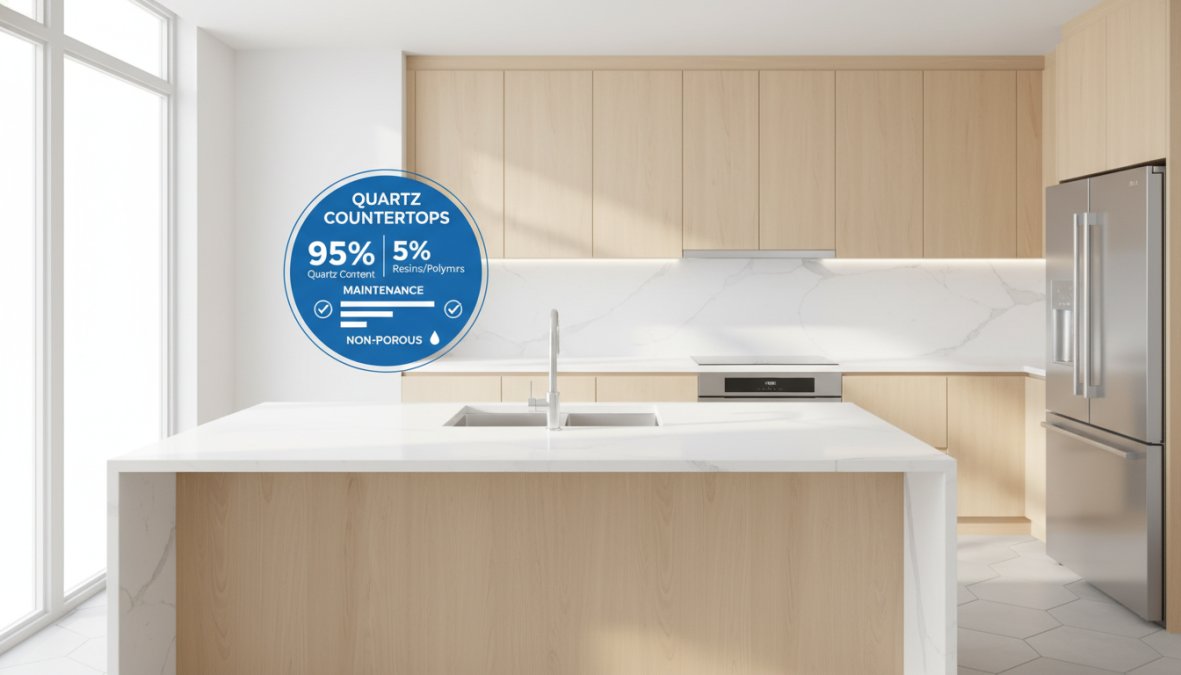
Quartz countertops are the most practical choice for most busy households because they combine non-porous construction with consistent aesthetics and near-zero maintenance. As an engineered stone, quartz is composed of roughly 90-95% ground natural quartz bound with polymer resins, which produces a hard, non-absorbent slab that never needs sealing.
 kitchen with white engineered quartz countertops featuring a polished finish, stainless steel appliances, and light wood cabinetry bathed in natural morning light from large windows](https://cdn.grandranker.com/articles/best-materials-for-kitchen-countertops-2026-guide-content-1-1780105862.jpg)
The practical advantages are significant. Quartz resists stains from wine, oil, and coffee without any treatment. Scratch resistance is high, though not as high as granite or Dekton. The one genuine weakness is heat: polymer resins can discolor or crack under direct heat from pots and pans, so trivets are non-negotiable.
Top Quartz Brands: Cambria, Silestone, Caesarstone, and MSI Q
Cambria is the premium American-made option in the quartz category. With over 200 designs, a non-porous and non-absorbent surface, and a full lifetime warranty, it’s the right choice for homeowners who want domestic manufacturing and a design library that goes beyond the standard grey-and-white palette. The trade-off is a premium price point relative to comparable engineered stone.
Silestone by Cosentino brings HybriQ+ technology to the category, which incorporates recycled water and renewable energy in production. For homeowners who factor environmental impact into purchasing decisions, Silestone is the most credible option. It’s available in polished, suede, and volcano textures, which gives designers more surface variation than most competitors offer.
Caesarstone is the workhorse of the category: consistent color and pattern across slabs, wide availability in design showrooms, and strong stain and moisture resistance. It’s particularly well-suited to modern kitchens where visual uniformity matters. The limitation is the same as all quartz: it’s not heat-proof and requires trivets.
MSI Q Quartz offers the broadest range of stone-look designs at competitive price points, with a lifetime residential warranty. Regional availability can vary, but for Norwalk, CT homeowners comparing value, MSI Q often delivers the closest visual match to natural marble or granite at a lower installed cost.
When selecting quartz, order physical samples rather than relying on screen images. Quartz slabs can vary significantly in veining intensity and background tone between production runs, even within the same product line.
Granite Countertops: Classic Natural Stone With Enduring Appeal
Few natural stone surfaces match granite for sheer durability. Granite is an igneous rock that ranks high on the hardness scale, resisting scratches from knives and keys, handling heat from pots better than quartz, and developing a surface that can last decades with proper care. According to the National [Kitchen(/2026/05/26/kitchen-remodeling-companies/) and Bath Association’s design guidance | nkba.org], natural stone countertops consistently rank among the most requested features in kitchen remodels.
The honest caveat: granite is porous and requires sealing, typically once a year to once every two years depending on the stone’s density and finish. A honed finish is more porous than a polished finish and needs more frequent attention. Neglected sealing leads to staining and, over time, bacterial penetration in the surface.
Every granite slab is unique, which is both the appeal and the complication. Matching slabs across a large kitchen requires careful selection at the stone yard. Fabrication and installation require professional expertise to handle the weight and execute precise cuts around sinks and appliances.
Never buy granite countertops without visiting the stone yard and selecting your specific slab. Online samples and showroom displays rarely capture the full variation in veining and color. Two slabs labeled identically can look completely different.
Pros and Cons of Quartz vs Granite for Kitchen Countertops
The pros and cons of quartz vs granite come down to a single core trade-off: engineered consistency versus natural character. Here’s the honest breakdown:
| Feature | Quartz | Granite |
|---|---|---|
| Porosity | Non-porous; no sealing needed | Porous; annual sealing required |
| Heat Resistance | Moderate; trivets required | High; handles hot pots better |
| Scratch Resistance | High | Very high |
| Appearance | Consistent across slabs | Unique; variation between slabs |
| Maintenance | Soap and water only | Seal 1-2x per year |
| Repairability | Difficult to repair chips | Chips can be filled by professionals |
| Typical Cost Range | Mid to high | Mid to high |
| Environmental | Polymer resins in composition | Quarried natural stone |
The verdict: quartz wins for households that want low maintenance and consistent aesthetics. Granite wins for cooks who want heat resistance, natural stone character, and are willing to maintain a sealing schedule. Both hold home value well, and both are appropriate for a kitchen remodel in most price ranges.
Marble, Soapstone, and Butcher Block Countertops Compared
Natural stone and wood surfaces each bring something quartz and granite cannot replicate: genuine material history, tactile character, and a surface that changes with use rather than resisting it. Marble has veining formed over millions of years. Soapstone develops a patina unique to each household. Butcher block carries the warmth of real wood grain and the rare ability to be fully restored at home. The shared requirement across all three is honest maintenance expectations, and an understanding of how your local climate affects each material differently.
Marble Countertops: Beauty, Etching, and Maintenance Reality
Marble countertops are the most misunderstood surface in the category. The aesthetic is unmatched: white or grey backgrounds with natural veining that makes every slab unique. Carrara is the most widely available variety, with soft grey veining on a white background and a relatively accessible price point within the marble category. Calacatta features bolder, more dramatic veining with a brighter white background and commands a significant premium, it is also more frequently imitated in quartz, which speaks to its desirability. Statuario sits between the two in veining intensity and is prized for large kitchen islands where the veining becomes a focal feature.
The etching mechanism explained: Marble is calcium carbonate. When an acid, lemon juice, vinegar, wine, tomato sauce, or even some hand soaps, contacts the surface, a chemical reaction dissolves a microscopic layer of the stone. The result is a dull, matte mark on a polished finish. This is not a stain that sealing prevents; it is a surface alteration that sealing cannot stop. This distinction matters enormously when evaluating marble for a kitchen.
Finish selection changes the calculus. A honed (matte) finish shows etching far less obviously than a polished finish because the surface already lacks reflectivity. Many kitchen designers now specify honed marble specifically for this reason. The trade-off is that honed marble is more porous than polished and absorbs staining agents more readily, requiring more frequent sealing, typically every six months rather than annually.
DIY repair for marble: Etching on a polished marble surface can be partially addressed at home using marble polishing powder (tin oxide-based products are widely available from stone supply retailers). The powder is worked into the etched area with a damp cloth in a circular motion, then buffed dry. Results vary depending on etch depth, light etching responds well; deep etching from prolonged acid contact may require professional re-polishing with diamond abrasives. Chips at edges can be filled with color-matched epoxy, but achieving an invisible repair on marble’s complex veining is difficult without professional matching.
Climate note for Connecticut homeowners: Marble is relatively stable in humid climates compared to wood, but thermal cycling, the shift between summer humidity and dry winter heat from forced-air systems, can stress grout lines and adhesive bonds in marble tile applications. For slab marble countertops, this is less of a concern, but homeowners should ensure the substrate and support structure are solid before installation.
Best fit: Bakers who want a naturally cool surface for pastry work. Homeowners who prioritize aesthetics and accept that the surface will develop a lived-in character. Households with low acid exposure in daily cooking. Specify honed over polished for kitchen applications.
Soapstone Countertops: Patina, Heat Resistance, and Regional Availability
Soapstone is the most underrated countertop material in the category, and it is genuinely distinct from every other natural stone option in ways that matter practically.
Why soapstone behaves differently from granite and marble: Soapstone is composed primarily of talc, chlorite, and magnesite, not silica or calcium carbonate. This composition makes it chemically inert (acids do not etch it), naturally non-porous (no sealing required), and an excellent conductor and retainer of heat. The same thermal properties that make soapstone ideal for wood stoves and laboratory countertops make it exceptional in a kitchen: it handles hot pots directly without damage, and it stays cool to the touch in ambient conditions.
The patina process: New soapstone is typically a medium grey with greenish undertones. Over months and years of use, oxidation darkens the surface to a deep charcoal or near-black tone. Applying food-grade mineral oil accelerates this process and evens out the color development, which is why most fabricators recommend oiling new soapstone immediately after installation. The oil does not seal or protect the stone, it is purely cosmetic, deepening the color and masking the uneven patina that develops from differential use across the surface.
Scratch resistance and DIY repair: Soapstone is softer than granite or quartz, it scores roughly 1 on the Mohs hardness scale in its talc-dominant varieties, though kitchen-grade soapstone with higher magnesite content is harder. Scratches from knives or rings will appear. The practical advantage is that scratches on soapstone blend into the developing patina over time rather than standing out as bright marks. For visible scratches, light sanding with 220-grit sandpaper followed by mineral oil application restores the surface effectively, a genuine DIY repair that requires no special tools or materials.
Regional availability, a real constraint: Soapstone quarrying in the United States is concentrated primarily in Virginia (the Alberene and Nelson County deposits) and in Brazil. Not all fabricators carry it, and slab inventory is considerably thinner than for granite or quartz. In Connecticut and the broader Northeast, soapstone is available but requires sourcing from specialized stone yards. Homeowners in Norwalk should verify local fabricator inventory and lead times before committing, a six-to-eight-week lead time is not unusual for soapstone compared to two-to-three weeks for stocked quartz.
Water hardness interaction: Connecticut’s water hardness varies by municipality, but much of Fairfield County draws from moderately hard water sources. Hard water leaves mineral deposits (calcium and magnesium scale) on countertop surfaces. On polished granite or marble, these deposits are visible and require acidic cleaners to remove, which creates a conflict with marble’s acid sensitivity. Soapstone’s chemical inertness means it tolerates a wider range of cleaners, including diluted vinegar solutions, without surface damage. This is a practical advantage in hard-water households that is rarely discussed in countertop guides.
Best fit: Homeowners who want a non-porous natural stone with zero sealing requirements. Cooks who use the stovetop heavily and want heat resistance without trivets. Kitchens with dark or warm cabinet tones where soapstone’s deepening patina complements the palette. Buyers willing to verify local fabricator availability before committing.
Butcher Block Countertops: Food Preparation, Hygiene, and DIY Repair
Butcher block countertops are the most repairable surface in the entire countertop category, and repairability is a more significant practical advantage than most buyers appreciate until they are living with a countertop that cannot be fixed.
Wood species and their trade-offs: Not all butcher block is equivalent. Hard maple is the industry standard for cutting surfaces: tight grain, high hardness (1,450 lbf on the Janka scale), and good resistance to knife marks. Walnut offers a darker, richer aesthetic with slightly lower hardness but exceptional visual appeal for design-forward kitchens. Teak is naturally high in silica and oils, making it more moisture-resistant than maple, a meaningful advantage in kitchens near sinks, but it dulls cutting tools faster. Acacia is widely available at lower price points but has a more variable grain pattern and can be prone to movement in humidity-variable environments.
The hygiene question, answered specifically: Research from food safety institutions indicates that wood surfaces can harbor bacteria in surface cuts and grain, but that properly maintained and oiled wood surfaces are effectively sanitized through routine cleaning. The key mechanism: food-grade mineral oil fills the wood’s pores, reducing the depth to which bacteria can penetrate and making surface cleaning more effective. A dry, unfinished, or cracked butcher block surface is a hygiene risk; a well-oiled surface with an intact finish is not meaningfully different from other countertop materials in food safety terms. Diluted food-safe sanitizers (such as a 1 tablespoon bleach per gallon of water solution) can be used periodically for deeper sanitation without damaging the wood if rinsed promptly.
DIY repair, the full process: This is where butcher block genuinely separates from every other countertop material. A scratched, stained, or knife-marked butcher block surface can be restored at home:
- Sand the affected area with 80-grit sandpaper to remove the damage, working with the grain.
- Progress to 120-grit, then 220-grit, feathering the edges of the sanded area into the surrounding surface.
- Wipe clean with a damp cloth and allow to dry completely.
- Apply food-grade mineral oil generously, allow it to absorb for 20-30 minutes, then wipe off the excess.
- Repeat the oil application two to three times over 24 hours for a freshly sanded surface.
No other countertop material, not quartz, not granite, not marble, allows a homeowner to fully restore a damaged surface without professional intervention. This repairability also means butcher block has a longer effective lifespan than its nominal 20-year estimate suggests: a well-maintained surface can be sanded and refinished multiple times over decades.
Climate and humidity considerations for Connecticut: This is the most important practical caveat for Norwalk homeowners. Wood moves with moisture, it expands in humid summer conditions and contracts in dry winter conditions when forced-air heating reduces indoor humidity significantly. This seasonal movement can cause butcher block to crack along the grain, warp, or open gaps at seams if it is not properly maintained or if it is installed in a configuration that restricts movement. Key installation rules: never glue butcher block to a rigid substrate across its full width; use clips or fasteners that allow lateral movement; maintain the oil finish consistently to slow moisture exchange. Butcher block installed near a sink is at higher risk and should be sealed with a more moisture-resistant finish (such as a food-safe oil-varnish blend) rather than pure mineral oil alone.
Cabinet compatibility: Butcher block pairs naturally with farmhouse, transitional, Shaker, and cottage cabinet styles where the organic texture reinforces the design language. It reads as incongruous against flat-front modern cabinetry where the design intent is material uniformity and clean lines. The most functional application in most kitchens is a butcher block island or prep section paired with stone perimeter countertops, combining the repairability and warmth of wood where food preparation happens most with the durability and stain resistance of stone everywhere else.
Best fit: Homeowners who want a repairable, renewable surface and are committed to a consistent oiling schedule. Kitchens with farmhouse, Shaker, or transitional cabinet styles. Island or prep-zone applications rather than full perimeter countertops in high-humidity environments. Buyers who source FSC-certified wood for a sustainable material profile.
Avoid installing butcher block directly adjacent to a dishwasher without a moisture barrier between the cabinet and the wood. Steam and heat from dishwasher cycles are a primary cause of warping and delamination in butcher block countertops near appliances.
For Connecticut kitchens with significant seasonal humidity swings, run a humidifier in winter to keep indoor relative humidity above 35%. This reduces the moisture differential that causes wood countertops to crack and shrink during the heating season, the same practice that protects hardwood floors applies directly to butcher block countertops.
High-Performance and Budget Options: Dekton, Laminate, Solid Surface, and More
The countertop market has expanded well beyond stone and wood. Ultra-compact surfaces now compete with natural stone on durability, while laminate has closed much of the aesthetic gap with engineered stone. Knowing which tier fits your budget and use case is straightforward once you understand what each material actually does.
Dekton, Neolith, and Porcelain: Ultra-Compact Surfaces
Dekton by Cosentino is the most technically capable countertop surface available. It’s manufactured through a process that sinters raw materials from glass, porcelain, and quartz under extreme pressure and heat, producing a surface with essentially zero porosity, extreme scratch resistance, and heat resistance that allows direct contact with hot pans. It’s also UV-stable, making it the right choice for outdoor kitchens and spaces with heavy sun exposure.
The limitation is installation: Dekton requires specialized fabricators and is unforgiving during cutting and fitting. Mistakes are expensive. It also sits at the high end of the cost range.
Neolith is a sintered stone surface with similar properties, available in large-format slabs that minimize seams across long countertop runs. The eco-friendly natural composition appeals to buyers focused on long-term environmental impact. Like Dekton, it demands professional installation.
Porcelain slabs have entered the countertop category as a credible alternative to natural stone. Large-format porcelain tiles or slabs offer heat resistance, stain resistance, and a maintenance-free surface at a lower cost than ultra-compact surfaces. The aesthetic range now includes convincing marble and concrete looks.
Laminate, Solid Surface, Recycled Glass, and Terrazzo
Laminate has a reputation problem it no longer deserves. Modern options from Formica and Wilsonart include surface textures that convincingly mimic stone and wood grain. Both are highly affordable, easy to install, and low maintenance. The honest limitations: laminate is prone to scratching and heat damage, and chips or burns are effectively irreparable. It’s the right choice for budget-conscious remodels, rental properties, or secondary kitchen spaces.
Solid surface materials like Corian offer something no other countertop does: virtually invisible seams and integrated sink designs. Scratches and dents can be sanded or buffed out, making it one of the most repairable options available. The trade-off is lower heat and scratch resistance compared to stone.
Recycled glass countertops embed glass fragments in cement or resin binders, producing a distinctive aesthetic with genuine sustainability credentials. The material is non-porous when resin-based, though cement-based versions require sealing. Availability is limited compared to mainstream options.
Terrazzo has returned to kitchen design after decades as a flooring material. Polished terrazzo countertops offer a unique aggregate aesthetic, good durability, and a genuinely sustainable profile when made with recycled materials. Fabrication is specialized and costs are typically high.
Kitchen Countertop Cost Comparison: Price Per Square Foot Breakdown
Understanding kitchen countertop cost by material is one of the most searched sub-topics in any remodel guide, and most buyers arrive at this section with a specific budget ceiling in mind. The ranges below reflect fully installed costs, material, fabrication, edge profiling, and professional installation, as typically quoted in the Northeast and Connecticut market. Raw slab prices alone can be misleading by 40-60% once fabrication labor is added.
| Material | Installed Cost (per sq ft) | Sealing Required | Expected Lifespan |
|---|---|---|---|
| Laminate (Formica, Wilsonart) | $15-$40 | No | 10-15 years |
| Butcher Block (solid hardwood) | $40-$100 | Yes (mineral oil) | 20+ years with care |
| Solid Surface (Corian, HI-MACS) | $45-$100 | No | 15-20 years |
| Tile (ceramic or porcelain) | $25-$65 | Grout only | 20+ years |
| Quartz, value tier (MSI Q, IKEA Kasker) | $55-$90 | No | 25+ years |
| Quartz, mid tier (Caesarstone, Cambria entry) | $80-$130 | No | 25+ years |
| Quartz, premium tier (Cambria, Silestone HybriQ+) | $100-$160 | No | 25+ years |
| Granite, standard slabs | $50-$110 | Yes (1-2×/year) | Lifetime |
| Granite, exotic or rare slabs | $100-$200+ | Yes | Lifetime |
| Soapstone | $80-$150 | No (oil optional) | Lifetime |
| Marble (Carrara, Calacatta) | $75-$200+ | Yes (2×/year) | Lifetime with care |
| Porcelain slab | $55-$120 | No | 20+ years |
| Dekton / Neolith (ultra-compact) | $100-$200+ | No | Lifetime |
| Recycled Glass (resin-based) | $65-$150 | No | 20+ years |
| Terrazzo (custom poured) | $100-$250+ | Periodic sealing | 30+ years |
Ranges reflect Northeast U.S. installed pricing as of 2025-2026. Costs vary based on slab thickness (2 cm vs. 3 cm), edge profile complexity, number of sink and appliance cutouts, and regional labor rates. Exotic stone slabs at the high end of granite and marble can exceed these ranges significantly.
What Drives the Gap Between Low and High Estimates
The spread within each material category is not random. Three factors account for most of the variance:
1. Slab thickness. A 3 cm slab is structurally stronger and requires no plywood substrate, but costs more per square foot than a 2 cm slab that needs a built-up edge to look substantial. Most fabricators in Connecticut default to 3 cm for countertops; 2 cm is more common in tile and some porcelain applications.
2. Edge profile. A standard eased or beveled edge is included in most fabricator quotes. Upgrading to an ogee, waterfall, or mitered edge can add $15-$30 per linear foot to the total. A kitchen with 30 linear feet of countertop edge can see $450-$900 in edge-profile upcharges alone.
3. Cutouts and sink type. An undermount sink cutout typically adds $150-$300 to fabrication. A farmhouse apron-front sink requires additional support framing and custom fitting, often adding $300-$500 or more depending on the stone weight and cabinet modification required.
The 30-50% Fabrication Markup Rule
A pattern that surprises most first-time buyers: the installed cost of a countertop is routinely 30-50% higher than the slab material cost alone. A quartz slab priced at $60 per square foot at the distributor level commonly installs at $90-$110 per square foot once fabrication, templating, delivery, and installation labor are included. Always request an all-in quote that itemizes material, fabrication, and installation separately so you can compare contractors on equal footing.
Regional Availability and Its Effect on Price in Connecticut
This is a cost factor most national guides ignore entirely. In Fairfield County and the broader Connecticut market, quartz and granite are stocked by multiple local fabricators, which creates competitive pricing and shorter lead times, typically two to four weeks from selection to installation. Soapstone, recycled glass, and terrazzo require sourcing from specialized suppliers, and lead times can stretch to six to ten weeks. That extended timeline has a real cost: it can delay cabinet installation, appliance delivery, and project completion, adding indirect costs to what looks like a straightforward material choice.
Dekton and Neolith are distributed through Cosentino’s regional network; Connecticut homeowners have access through authorized dealers, but the pool of certified fabricators who can cut ultra-compact surfaces without cracking is smaller than for conventional stone. Fewer fabricators means less price competition, expect quotes at the upper end of the range.
The total installed cost of a countertop is routinely 30-50% higher than the slab price alone. Always request itemized quotes covering material, fabrication, edge profiling, cutouts, and installation. A $60/sq ft slab can easily install at $95-$115/sq ft once all costs are included.
If your project includes an island, price it separately. Island countertops often require larger slab sections, waterfall edges, or seam placement decisions that add disproportionate cost relative to perimeter countertops. Getting a line-item breakdown for the island versus perimeter surfaces helps identify where to adjust if the total quote exceeds budget.
Best Countertop Materials for Busy Kitchens in Norwalk, CT
Norwalk homeowners face a specific set of considerations that generic countertop guides don’t address. Connecticut’s climate brings humidity in summer and dry heat in winter from forced-air systems, which affects wood and natural stone differently than a stable climate would. Butcher block is more susceptible to warping and cracking in spaces with significant seasonal humidity swings, making mineral oil maintenance more important here than in drier climates.
For busy kitchens near me in Norwalk and the broader Fairfield County area, quartz is the dominant recommendation for primary countertop surfaces. It handles the daily abuse of an active household without demanding a maintenance schedule. For homeowners who want natural stone character, granite is the practical choice over marble, given the lower etching risk and stronger heat resistance.
Tony’s Home Improvement LLC works with Norwalk homeowners on kitchen remodels across all budget levels, sourcing materials economically and managing the full fabrication and installation process. The team’s familiarity with local suppliers means better pricing on quartz and granite than most homeowners can access independently, and the meticulous attention to detail on edge profiles and backsplash coordination prevents the costly mismatches that show up after installation.
Local fabricator availability also matters. Soapstone and recycled glass countertops require sourcing from specialized suppliers, and lead times in Connecticut can run longer than for standard quartz or granite. Build that into your project timeline.
How to Maintain Natural Stone Countertops and Extend Their Lifespan
Knowing how to maintain natural stone countertops properly is the difference between a surface that looks better at year ten than year one and one that requires costly refinishing. The core principle is simple: keep the stone sealed, clean spills quickly, and avoid acidic cleaners.
Sealing Schedules for Granite, Marble, and Soapstone
The water test is the most reliable way to determine when granite or marble needs resealing: pour a small amount of water on the surface and wait ten minutes. If the stone darkens around the water, the seal has degraded and resealing is overdue. If the water beads, the seal is intact.
General sealing guidelines:
- Granite: Seal once per year for most stones. Dense black granites may only need sealing every two years. Light-colored granites with visible porosity may need it twice yearly.
- Marble: Seal every six to twelve months. Honed marble needs more frequent sealing than polished because the open surface texture absorbs more readily.
- Soapstone: Does not require sealing due to its non-porous nature. Mineral oil application every few months deepens the patina and evens out surface color, but it’s cosmetic rather than protective.
Use a penetrating impregnating sealer, not a topical coating. Topical coatings sit on the surface and peel over time. Penetrating sealers enter the stone’s pores and repel liquids from within.
Repairability and DIY Maintenance Tips by Material
This is where material selection gets practical. Some surfaces can be repaired at home; others require professional intervention.
- Butcher block: Sand scratches and cuts with 120-grit sandpaper, progress to 220-grit, then apply food-safe mineral oil. Most surface damage disappears with a single pass.
- Solid surface (Corian): Light scratches buff out with a Scotch-Brite pad. Deeper damage requires wet sanding with 400-grit paper. Seams and chips should be handled by a certified fabricator.
- Granite: Small chips at edges can be filled with color-matched epoxy kits available from stone suppliers. Major cracks require professional repair.
- Quartz: Chips and cracks are difficult to repair invisibly. Color-matched epoxy helps but rarely disappears completely. Prevention through trivets and avoiding impact on edges is more effective than repair.
- Marble: Etching from acid can be polished out on a polished finish using marble polishing powder. Honed finishes are harder to restore to an even sheen without professional refinishing.
According to the Marble Institute of America’s care guidelines, consistent use of pH-neutral cleaners is the single most effective daily maintenance practice for extending natural stone countertop lifespan.
Environmental Impact, Recyclability, and Long-Term Value
The environmental profile of countertop materials is genuinely complex, and most buying guides skip it entirely. Here’s the honest picture.
Quarried natural stone carries the environmental cost of extraction, transportation, and fabrication waste. However, natural stone is infinitely durable, requires no synthetic inputs during its lifespan, and can be reclaimed and repurposed at end of life. A granite countertop removed during a renovation can become flooring, garden stone, or be donated for reuse.
Quartz engineered stone contains polymer resins derived from petrochemicals. It’s not recyclable in the conventional sense. Silestone’s HybriQ+ technology represents a genuine improvement in production sustainability, but the end-of-life picture for engineered stone remains a disposal challenge rather than a recycling opportunity.
Dekton and Neolith, as sintered surfaces with natural mineral compositions, have better recyclability profiles than polymer-resin quartz. Their durability also means replacement is less frequent, which reduces lifecycle environmental impact.
Laminate is the least sustainable option across the lifecycle. It degrades, cannot be recycled, and contributes to landfill volume. Its low cost and short lifespan mean it gets replaced more frequently than any other material.
Recycled glass countertops offer the most compelling sustainability story: they divert post-consumer glass from landfills and produce a durable surface with a genuinely circular material input. As documented in the U.S. Green Building Council’s LEED materials criteria, countertop materials with recycled content can contribute to green building certification points.
Butcher block from certified sustainable forestry sources (look for FSC certification) is a renewable material with a strong environmental profile, particularly when it lasts decades with proper maintenance.
Choosing the Best Materials for Kitchen Countertops: Final Recommendations
The best materials for kitchen countertops are not universal. They’re situational. Here’s the clearest decision framework available:
Choose quartz if you want low maintenance, consistent aesthetics, and non-porous hygiene for a high-traffic kitchen. Caesarstone and MSI Q offer strong value; Cambria and Silestone justify their premium for specific design and sustainability priorities.
Choose granite if you cook heavily, want heat resistance, and appreciate natural stone variation. Commit to the sealing schedule or don’t buy it.
Choose marble if aesthetics are the priority and you accept that the surface will develop a lived-in character over time. Honed finish over polished for kitchens.
Choose soapstone if you want a non-porous natural stone with a developing patina and exceptional heat resistance. Verify local fabricator availability in Connecticut before committing.
Choose butcher block for islands or prep sections where repairability and warmth matter more than stone durability. Avoid it as the primary surface in high-humidity kitchens without a strong maintenance commitment.
Choose Dekton or Neolith for outdoor kitchens, extreme-use environments, or modern kitchens where maximum durability and large-format slabs are the priority.
Choose laminate for budget remodels, rental properties, or secondary spaces where cost efficiency outweighs long-term performance.
For homeowners in Norwalk and across Fairfield County, matching material to lifestyle produces better results than chasing the most popular choice. The right countertop is the one you’ll still be happy with in year fifteen.
A kitchen remodel is a significant investment, and countertop selection is where most homeowners either gain or lose long-term satisfaction with the result. Tony’s Home Improvement LLC brings professional expertise, economical material sourcing, and meticulous attention to detail to every kitchen project in Norwalk, CT. From material selection through fabrication coordination and final installation, the team handles every step with clear communication and a clean, professional work environment. Contact Tony’s Home Improvement LLC to discuss your kitchen countertop project and get a cost-effective solution tailored to your kitchen’s specific demands.
Frequently Asked Questions
What is the most durable material for kitchen countertops?
Among the best materials for kitchen countertops, engineered stone options like quartz, Dekton, and Neolith sintered stone rank highest for durability. They offer exceptional scratch resistance, stain resistance, and are non-porous, meaning they resist moisture and bacteria. For natural stone, granite is widely considered the most durable option. Dekton in particular stands out for extreme heat resistance and UV stability, making it suitable for both indoor and outdoor high-traffic kitchens.
How much do different kitchen countertop materials cost per square foot?
A kitchen countertop cost comparison typically shows laminate as the most affordable option, often starting well below natural stone. Butcher block and solid surface materials fall in the mid-range. Granite and quartz generally occupy a mid-to-premium tier, while marble, soapstone, Dekton, and Neolith sintered stone sit at the higher end. Fabrication complexity, edge profiles, and installation labor in areas like Norwalk, CT can significantly affect the final square foot cost for any material.
Is quartz better than granite for kitchen countertops?
The pros and cons of quartz vs granite depend on your priorities. Quartz is a non-porous engineered stone requiring no sealing and offering consistent veining patterns, making it more maintenance-free. Granite is a natural stone with unique slab character, strong heat resistance, and often competitive pricing, but it requires periodic sealing to prevent staining. For busy kitchens prioritizing hygiene and low upkeep, quartz typically wins. For those who value natural stone aesthetics and heat resistance, granite remains a strong choice.
Do marble countertops stain and scratch easily?
Yes, marble is a porous natural stone prone to etching from acidic substances like lemon juice, vinegar, and wine, as well as staining if not properly sealed. A honed finish can hide minor scratches better than a polished finish, but marble still demands more attentive maintenance than quartz or granite. Regular sealing and prompt cleanup of spills are essential. Marble is best suited to kitchens where aesthetics are prioritized and the owner accepts its patina-developing character over time.
What are the easiest kitchen countertops to maintain?
Engineered quartz surfaces from brands like Cambria, Caesarstone, and Silestone are among the easiest to maintain because they are non-porous, require no sealing, and resist stains and scratches with simple soap-and-water cleaning. Solid surface materials like Corian are also low-effort and uniquely repairable, minor scratches can be sanded out. Laminate requires minimal maintenance but cannot be repaired easily once damaged. For natural stone, knowing how to maintain natural stone countertops through regular sealing is key to longevity.
Which countertop materials are best for the environment and long-term sustainability?
Silestone by Cosentino uses HybriQ+ technology for more sustainable production, while Neolith sintered stone features a natural mineral composition with no polymer resins. Recycled glass countertops incorporate post-consumer materials, and butcher block from sustainably sourced wood is a renewable option. Natural stones like granite and soapstone are long-lasting, reducing replacement frequency. When evaluating environmental impact, consider not just material composition but also fabrication energy use, regional availability to reduce transport emissions, and end-of-life recyclability.
This article was written using GrandRanker
 Tony's Home Improvement LLC
Leave a comment