
Table of Contents
- Renovation vs. Custom Build: A Side-by-Side Comparison
- Cost of Renovating vs Building New: What to Actually Budget For
- Is It Worth Renovating an Old House? How to Evaluate Your Home
- Pros and Cons of Custom Home Building vs. Renovation
- Renovation Timeline vs New Construction: What Takes Longer?
- Financing Your Choice: Loans, Equity, and Renovation Budgets
- Choosing Between Renovation and Custom Build: A Decision Framework for Norwalk Homeowners
- Conclusion
Last Updated: June 6, 2026
Choosing between renovation and custom build is one of the most consequential decisions a homeowner can make. At Tony’s Home Improvement LLC, we work with Norwalk, CT homeowners every week who arrive at this crossroads without a clear framework. This guide gives you the exact criteria, cost breakdowns, and financing strategies you need to make the right call.
Most guides treat this as a binary choice based purely on budget. The real decision hinges on land availability, construction risk tolerance, available equity, and what the Norwalk market will actually reward when you sell.
Renovation vs. Custom Build: A Side-by-Side Comparison
Renovation transforms an existing structure, working within its bones. Custom building starts from a cleared lot and constructs entirely to specification. The table below covers the criteria that matter most to Norwalk homeowners:
| Factor | Renovation | Custom Build |
|---|---|---|
| Typical timeline | 3-9 months | 12-24 months |
| Cost predictability | Moderate (hidden costs common) | Low (scope changes frequent) |
| Land required | No | Yes |
| Permits and approvals | Partial | Full set required |
| Design flexibility | Limited by existing structure | Complete |
| Financing options | HELOC, home equity loan, FHA 203(k) | Construction loan, cash-out refinance |
| Disruption to living | High if occupied | Low (can stay in current home) |
| ROI potential | High on targeted upgrades | Depends heavily on land cost and market |
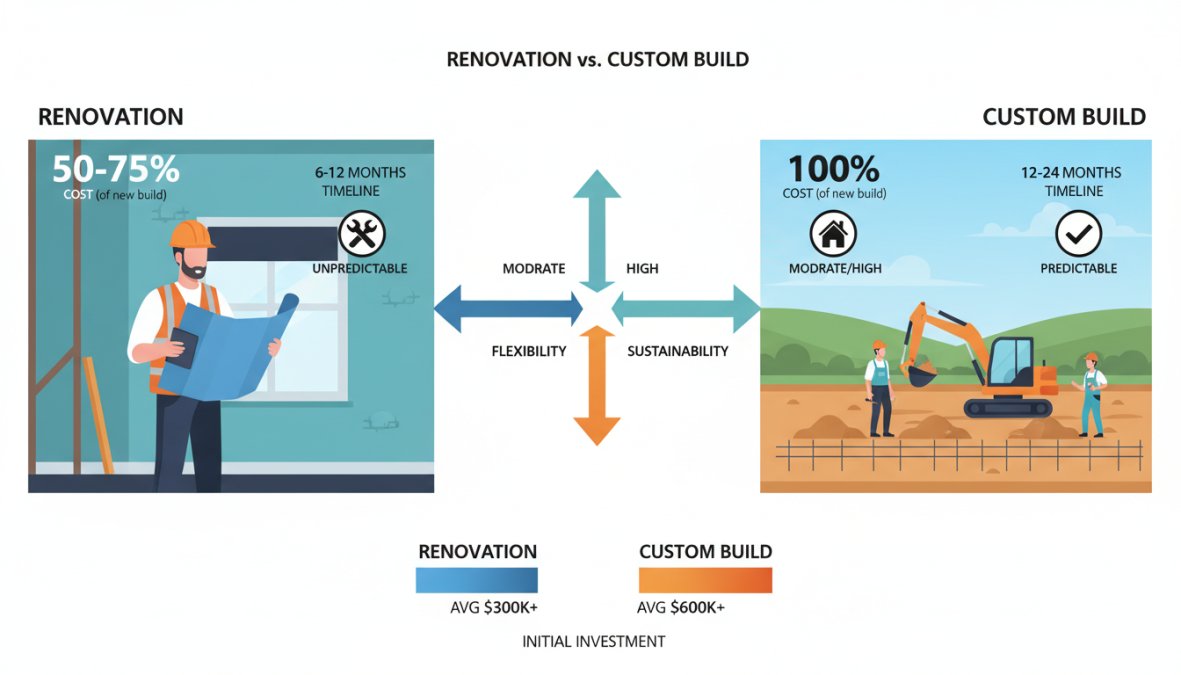
The single most important variable is your existing home’s structural integrity. If the foundation, roof system, and load-bearing walls are sound, renovation almost always delivers better value per dollar in established markets like Norwalk. If the structure is compromised or the lot is too small for your needs, the math shifts toward building new.
Renovation wins on cost efficiency and timeline in most Norwalk markets. Custom building wins on design control and long-term fit when the right lot is available at the right price.
Cost of Renovating vs Building New: What to Actually Budget For
Most homeowners dramatically underestimate both paths. Renovation budgets routinely expand by a third once walls open up, and custom builds frequently run over due to material delays, design changes, and site conditions.
In Norwalk, CT, where labor costs track with the broader Fairfield County market, whole-home renovation costs run significantly lower per square foot than custom construction, before land is even factored in. According to Remodeling Magazine’s Cost vs. Value Report, the gap between renovation and new construction costs has widened over the past three years as material and labor costs have risen unevenly across project types.
Hidden Costs of Renovating an Old House
Older Norwalk homes, particularly those built before 1980, carry predictable hidden cost triggers. Budget for these before you commit:
- Asbestos and lead abatement: Required when disturbing walls, flooring, or pipe insulation in pre-1980 construction.
- Electrical panel upgrades: Most older homes run 100-amp service; modern kitchens and additions typically require 200-amp panels.
- Structural surprises: Sagging joists, undersized beams, and water-damaged subfloors only reveal themselves after demolition begins.
- Code compliance: Bringing older structures up to current Connecticut building code adds cost, particularly for egress windows, staircase dimensions, and HVAC.
- Temporary housing: Factor in three to six months of alternative housing costs if the home becomes uninhabitable.
The rule of thumb among experienced contractors: add 15-20% to any renovation estimate as a contingency reserve for homes built before 1985.
Hidden Costs of Custom Home Construction
Custom builds carry a different set of surprises, most front-loaded before a single wall goes up:
- Land and site preparation: In Norwalk, buildable lots are scarce. Clearing, grading, and utility connections add cost before construction begins.
- Design and engineering fees: Architectural drawings, structural engineering, and permit sets typically represent a meaningful percentage of total project cost.
- Construction loan carrying costs: You pay interest on the drawn balance throughout construction, on an 18-month build, this adds up significantly.
- Landscaping and site finishing: Driveway, grading, seeding, and landscaping are separate line items most initial budgets omit.
- Temporary housing for the full build duration: Unlike a renovation where you might manage in place, a custom build requires housing for 12-24 months.
Never sign a construction contract without a detailed draw schedule that ties payments to verified milestones. Contractors who request large upfront payments without milestone-linked disbursements are a significant financial risk.
Is It Worth Renovating an Old House? How to Evaluate Your Home
Renovating an old house is worth it when the structure is sound, the location is strong, and the planned improvements align with what buyers actually pay for. It is not worth it when deferred maintenance has compounded into systemic failure across multiple systems simultaneously.
The honest evaluation starts with a pre-renovation inspection from a licensed structural engineer, not just a home inspector. Home inspectors identify symptoms; structural engineers diagnose causes. That engineering report is the single most valuable document you can have before committing to a Norwalk renovation.
ROI Analysis: Which Renovations Add the Most Home Value
Not all renovation spending returns equal value. According to Remodeling Magazine’s annual Cost vs. Value analysis, the highest-returning projects in the Northeast consistently include minor kitchen remodels, bathroom updates, and exterior improvements like siding replacement and entry door upgrades. Major kitchen overhauls and additions typically return less than their cost.
A practical ROI framework for renovation decisions:
- Get a pre-renovation appraisal. Know your current market value before spending anything.
- Research comparable sales. What are fully renovated homes in your specific Norwalk neighborhood selling for? That ceiling defines your maximum renovation investment.
- Calculate your equity position. Subtract your mortgage balance from the post-renovation value estimate to see whether the project pencils out.
- Apply the 70% rule. Your total investment should not exceed 70% of the post-renovation value if you plan to sell within five years.
Pros and Cons of Custom Home Building vs. Renovation
Pros and Cons of Renovation
Pros:
- Faster completion: most projects finish in 3-9 months versus 12-24 for new construction
- Established neighborhood with known infrastructure, schools, and community
- Lower total cost, particularly for targeted upgrades
- Broader, more favorable financing options (HELOCs, home equity loans)
- Preserves existing equity and avoids land acquisition costs
Cons:
- Hidden structural and systems costs are common, especially in older homes
- Design is constrained by the existing floor plan and structural layout
- Living through a major renovation is genuinely disruptive
- Older systems may require full replacement, not just repair
- Resale value is capped by the neighborhood regardless of renovation quality
Pros and Cons of Custom Build
Pros:
- Complete design control from foundation to finish
- Modern systems and materials throughout with no deferred maintenance risk
- Energy efficiency built in from the start, reducing long-term operating costs
- No compromise on layout, room sizing, or feature selection
- New construction warranty protection on structure and systems
Cons:
- Significantly higher total cost, particularly when land acquisition is included
- Longer timeline with more opportunity for cost overruns and delays
- Construction loans carry higher rates and more complex qualification requirements
- Finding a buildable lot is genuinely difficult in Norwalk
- Greater exposure to material cost volatility over a multi-year build period
Renovation Timeline vs New Construction: What Takes Longer?
New construction takes longer. A well-managed whole-home renovation in Norwalk typically runs three to nine months. A custom build rarely completes in under 12 months and frequently stretches to 18-24 months when permitting delays, weather, and subcontractor scheduling are factored in.
The renovation timeline advantage is real, but scope creep and hidden conditions can extend timelines significantly. A kitchen remodel planned for eight weeks can stretch to five months when asbestos remediation, structural repairs, and permit delays stack up.
Understanding Draw Schedules and Contractor Payment Timelines
A draw schedule governs how and when funds are released to contractors. For custom builds financed with a construction loan, the lender controls disbursements directly, releasing funds only after an inspector verifies each phase is complete. For renovations, draw schedules are negotiated between homeowner and contractor. A reasonable structure for a major renovation:
- Mobilization draw (10-15%): Released at contract signing for materials procurement and setup
- Rough-in completion draw (25-30%): Released after framing, rough electrical, and rough plumbing are inspected
- Drywall and mechanicals draw (25%): Released after drywall, HVAC, and insulation are complete
- Finish work draw (20-25%): Released after flooring, cabinetry, and trim are installed
- Final draw (10-15%): Released after punch list completion, final inspection, and certificate of occupancy
Never release the final draw until you have walked through the completed project with your contractor and confirmed every punch list item is resolved. The final payment is your primary leverage for getting corrections made.
Project management tools like Buildertrend help contractors and homeowners track draw schedules against verified milestones, reducing payment disputes on complex multi-phase projects.
Financing Your Choice: Loans, Equity, and Renovation Budgets
Financing is where the renovation vs. custom build decision often gets made by default rather than by design. Renovation projects benefit from a broader menu of secured loan options tied to existing equity. Custom builds require construction loans with higher rates, stricter qualification criteria, and more complex disbursement processes.
According to Consumer Financial Protection Bureau guidance on home improvement financing, homeowners should compare APR across all financing options rather than focusing on monthly installments alone, since origination fees and closing costs significantly affect total borrowing cost.
Home Equity Loan vs. HELOC for Renovations
A home equity loan is a fixed-rate lump sum secured against your home’s equity, repaid in fixed monthly installments. A HELOC is a variable-rate revolving credit line with a draw period followed by a repayment period. For renovations with a well-defined scope, a home equity loan is often preferable, the fixed rate and lump sum match most contractor payment structures. For phased or uncertain-scope projects, a HELOC provides flexibility since you draw only what you need. Key eligibility factors for both:
- Loan-to-value ratio (LTV): Most lenders cap combined LTV at 80-85% of appraised value
- Credit score: Higher scores access better APR
- Debt-to-income ratio: Lenders evaluate total monthly debt against gross income
- Home equity: You need sufficient equity above your existing mortgage balance to qualify
The FHA 203(k) loan rolls purchase price and renovation costs into a single mortgage, valuable when buying a home that needs significant work before it is habitable.
Financing a Fixer-Upper vs. an Existing Home Remodel
When you own the home, you draw against established equity with a known appraisal baseline. When buying a fixer-upper, lenders must assess future value, introducing more underwriting complexity. The FHA 203(k) program and Fannie Mae’s HomeStyle Renovation loan are the two primary products for fixer-upper financing, both allowing borrowers to finance acquisition and renovation costs in a single loan with lender-controlled draw schedules tied to verified construction progress.
For homeowners who already own in Norwalk, a cash-out refinance is worth evaluating when current mortgage rates are favorable, it replaces your existing mortgage with a larger loan, with the difference paid as a lump sum for renovation work, though you extend your loan term and potentially increase your rate on the full balance.
Match your financing vehicle to your project structure. Fixed-scope renovations suit home equity loans. Phased projects suit HELOCs. Fixer-upper purchases suit FHA 203(k) or HomeStyle loans. Custom builds require construction loans with lender-controlled draw schedules.
Choosing Between Renovation and Custom Build: A Decision Framework for Norwalk Homeowners
The right answer comes down to five variables evaluated in sequence.
Step 1: Assess your existing structure honestly. Commission a structural engineering report before any other decision. If the foundation, framing, and primary systems are sound, renovation is your default path. If structural remediation costs alone approach new construction cost, the decision shifts.
Step 2: Define your non-negotiables. If required features are impossible within your existing floor plan, say, a ground-floor primary suite in a two-story colonial with no viable addition site, custom building may be the only path.
Step 3: Run the neighborhood value ceiling. Research top sale prices for fully renovated comparable homes within a half-mile. If your renovation investment plus current home value approaches that ceiling, you are over-improving for the market.
Step 4: Evaluate your financing position. Calculate your available equity, credit score, and debt-to-income ratio. Substantial equity and a strong credit profile make renovation financing accessible. If you are equity-light, construction loan qualification may be more challenging.
Step 5: Assess your timeline tolerance. If you need to be in your finished home within 12 months, renovation is almost certainly your only realistic option. Custom builds in Norwalk, factoring in lot acquisition, permitting, and construction, rarely complete within that window.
According to National Association of Realtors housing data, established neighborhoods in Fairfield County consistently command premiums that reward well-executed renovations, making the renovation path particularly compelling for homeowners who already own in desirable Norwalk locations.
Tony’s Home Improvement LLC works with homeowners at exactly this decision point, providing detailed project assessments, transparent cost estimates, and meticulous planning that prevents the budget overruns and timeline extensions that derail most renovation projects near me in Norwalk.
The hardest part of choosing between renovation and custom build is committing to a path before you have complete information, then managing the complexity that follows. Tony’s Home Improvement LLC brings professional expertise, economical material sourcing, and clear communication to every project, whether a targeted kitchen remodel or a major structural transformation. Contact Tony’s Home Improvement LLC to get a thorough assessment of your property and a realistic project plan before you commit to either path.
Frequently Asked Questions
Is it cheaper to renovate or build a new house?
Generally, renovating an existing home tends to cost less upfront than building a custom home from scratch, but this depends heavily on the scope of work. A full gut renovation of an older home can approach or exceed new construction costs once hidden issues like outdated wiring, plumbing, or structural repairs are factored in. For most homeowners, a targeted renovation with a clear scope is the more cost-effective path, while a custom build offers more predictable pricing on a per-square-foot basis.
How do I decide if my current home is worth renovating?
When choosing between renovation and custom build, assess three things: the structural integrity of your existing home, the loan-to-value ratio after improvements, and whether the renovated home will meet your long-term needs. If foundation, roof, or mechanical systems need replacement, costs can escalate quickly. A home in a desirable Norwalk neighborhood with solid bones is usually worth renovating. If the layout is fundamentally wrong for your lifestyle and land costs are reasonable, a custom build may deliver better long-term value.
What are the hidden costs of renovating an old house?
Hidden renovation costs are one of the biggest risks when choosing between renovation and custom build. Common surprises include asbestos or lead paint remediation, outdated knob-and-tube wiring, galvanized plumbing, insufficient insulation, and permit fees for bringing older systems up to current code. Experienced contractors recommend budgeting a 15-20% contingency on top of your renovation estimate specifically to cover these discoveries, which are especially common in older Connecticut homes built before the 1980s.
How long does a custom home build take compared to a renovation?
Renovation timelines vary widely: a kitchen remodel may take 6-12 weeks, while a whole-home renovation can run 6-18 months. Custom home construction in Connecticut typically takes 12-24 months from breaking ground to move-in, not counting the design, permitting, and land preparation phases, which can add another 6-12 months. Renovation timeline vs new construction comparisons must also account for the draw schedule, the staged payment and inspection process that governs how quickly work can progress on a new build.
Does a custom build increase property value more than a renovation?
A custom build gives you a brand-new home with modern systems, which typically commands a premium in resale. However, strategic renovations, particularly kitchen remodels, bathroom upgrades, and additions, can deliver strong ROI and significantly increase home value appreciation, especially in established neighborhoods where new land is scarce. In markets like Norwalk, CT, a well-executed renovation in a sought-after area can outperform a custom build in a less desirable location from a pure resale value standpoint.
This article was written using GrandRanker
 Tony's Home Improvement LLC
Leave a comment