
Table of Contents
- Why Hidden Costs Derail Home Renovation Budgets
- Building Your Home Renovation Contingency Budget
- Essential Questions to Ask Your Contractor Before Renovation
- Renovation Contract Clauses That Protect Homeowners From Surprise Costs
- Your Unexpected Renovation Problems Checklist
- Permits, Zoning Laws, and HOA Restrictions in Norwalk, CT
- Avoiding Hidden Costs Through Smart Material Selection and Eco-Friendly Sourcing
- The Psychological Impact of Remodeling and How to Stay in Control
- Conclusion
Last Updated: June 2, 2026
Renovation projects go sideways financially more often than most homeowners expect, and avoiding hidden costs home renovation is the single biggest challenge separating a successful remodel from a budget nightmare. At Tony’s Home Improvement LLC, we’ve seen firsthand how surprise expenses derail even well-planned projects in Norwalk, CT and the surrounding area. The good news: most of these costs are predictable if you know where to look. Below, we’ll show you exactly how to protect your budget, vet your contractor, and manage your project from the first conversation to the final walkthrough.
Here’s what most guides get wrong: they treat hidden renovation costs as bad luck. They’re not. They’re the predictable result of skipping specific steps in the planning and contracting process. The strategies in this guide address each of those steps directly.
Why Hidden Costs Derail Home Renovation Budgets
Renovation budgets fail because the scope of work is almost always underestimated at the start. A kitchen remodel that looks straightforward on paper can uncover outdated electrical wiring, deteriorating plumbing, or structural issues the moment walls come down. These aren’t surprises in the true sense; they’re risks that weren’t priced into the original estimate.
A hidden renovation cost is any expense not captured in the initial project bid that arises during construction due to unforeseen conditions, scope changes, or omissions in the original contract.
The problem compounds when homeowners treat the first contractor quote as a fixed price rather than an estimate. Change orders, material price fluctuations, permit fees, and subcontractor scheduling gaps all add cost. According to the National Association of Home Builders’ remodeling data, structural and mechanical surprises are among the most common sources of budget overruns in residential renovation.
Three factors consistently drive hidden costs:
- Incomplete site inspection before work begins – Problems behind walls, under floors, or in the attic remain invisible until demolition
- Vague scope of work in the construction contract – Ambiguous language creates room for disputes about what’s included
- No contingency budget – Without a financial buffer, the first unexpected cost forces a decision between stopping work or overspending
Avoiding hidden costs home renovation isn’t about finding the cheapest contractor. It’s about building a process that surfaces real costs before the project starts, not after.
Building Your Home Renovation Contingency Budget
Every renovation budget needs a contingency line. This is not optional, and treating it as optional is the most expensive mistake homeowners make.
How to Calculate the Right Contingency Percentage
The right contingency percentage depends on the age of your home, the complexity of the project, and whether structural, plumbing, HVAC, or electrical systems are involved.
A practical framework:
| Project Type | Recommended Contingency | Reason |
|---|---|---|
| Cosmetic updates (paint, fixtures) | 5-10% of budget | Low structural risk |
| Kitchen or bathroom remodel | 15-20% of budget | Plumbing and electrical exposure |
| Full gut renovation | 20-25% of budget | Maximum unknown risk |
| Older home (pre-1980) | Add 5% to any category | Higher probability of code issues |
For a Norwalk home built before 1980, a bathroom renovation with a rough budget of $30,000 should carry a contingency of at least $5,500 to $7,500. That number isn’t padding; it’s a realistic acknowledgment that older homes in Connecticut often have galvanized pipes, knob-and-tube wiring, or asbestos-containing materials that require remediation.
Never spend your contingency budget on upgrades mid-project. Homeowners frequently raid the contingency for premium tile or upgraded fixtures, then have nothing left when a real problem surfaces. Keep it separate and treat it as emergency funds only.
Financing Options Beyond Cash: Home Equity and More
Paying cash for a renovation isn’t the only option, and for larger projects, it’s often not the smartest one. Home equity products offer structured financing that keeps your cash liquid for contingencies.
The main options worth understanding:
- Home Equity Line of Credit (HELOC): A revolving credit line secured by your home’s equity. Useful for phased projects because you draw only what you need.
- Home Equity Loan: A lump-sum loan at a fixed rate. Better for projects with a firm total cost.
- FHA 203(k) Rehabilitation Loan: Combines purchase and renovation financing. Relevant if you’re buying and renovating simultaneously.
- Personal renovation loans: Unsecured, faster to obtain, but carry higher interest rates than equity-backed products.
The Consumer Financial Protection Bureau’s guide to home equity products outlines the key differences between these options and the risks of each. Review it before committing to a financing structure, especially if your renovation budget exceeds your liquid savings.
Essential Questions to Ask Your Contractor Before Renovation
Most homeowners treat the contractor interview as a formality after they’ve already decided based on price. That instinct is expensive. The interview is the single highest-leverage moment for avoiding hidden costs home renovation, because the answers, and the contractor’s reaction to the questions, reveal far more than any portfolio photo.
The questions below are organized by what they actually test, not just what they ask.
Questions That Test Financial Transparency
1. Walk me through how you build your estimate. What’s fixed and what’s an allowance?
This question separates contractors who price work from contractors who win bids. A contractor who can explain, line by line, which items are hard costs and which are allowance-based estimates is a contractor who understands their own numbers. Vague answers, "we’ll figure it out as we go" or "the estimate covers everything", are a warning sign. Allowance items are budget placeholders, not guarantees, and a contract heavy with allowances is a contract designed to grow.
2. What’s your payment schedule, and what triggers each payment?
The answer should describe milestone-based payments tied to inspectable work phases: permit issuance, rough framing, rough mechanical inspections, drywall, substantial completion, and final walkthrough. Any contractor requesting more than 10-15% upfront as a deposit, or asking for large draws before completing the corresponding phase, is asking you to finance their business with your money. That structure removes their incentive to finish on schedule.
3. How do you handle change orders? Show me an example.
Ask to see an actual change order document from a past project. It should include a written description of the scope change, a fixed dollar amount, a schedule impact in days, and a signature line for both parties before work proceeds. If the contractor doesn’t have a standard change order form, that tells you change orders are handled verbally, which means they’re handled in your contractor’s favor.
Questions That Test Operational Competence
4. Who specifically will be on my job site each day, and who is the site supervisor?
General contractors who win the bid and then hand the project to an unsupervised crew are a primary source of quality and schedule problems. You want a named site supervisor with a direct phone number, and you want to know how often the GC themselves will be on site. "I’ll check in regularly" is not an answer.
5. Which subcontractors will you use for electrical, plumbing, and HVAC, and are they licensed in Connecticut?
In Connecticut, electrical and plumbing work must be performed by licensed tradespeople. Ask for the names of the specific subs, not just confirmation that they’re licensed. Then verify those licenses independently through the Connecticut Department of Consumer Protection license lookup. A contractor who uses different subs on every job, rather than maintaining established relationships, has less control over scheduling, quality, and accountability.
6. What permits will this project require, and who pulls them?
The correct answer is that the contractor pulls the permits, not the homeowner. A contractor who asks you to pull your own permits is either unlicensed, trying to avoid a paper trail, or both. Permits pulled in the homeowner’s name also shift liability for code compliance to you. In Norwalk, structural, electrical, plumbing, and HVAC work all require permits. If your contractor says a project of that scope doesn’t need permits, verify that claim directly with the Norwalk Building Department before signing anything.
Questions That Test Track Record
7. Can you provide three references from projects similar in scope completed in the last 18 months?
Portfolio photos show you what a project looked like. References tell you what it was like to live through. When you call those references, ask four specific questions:
- Did the project finish within 10% of the original budget?
- How many change orders were issued, and were they explained before you approved them?
- When a problem came up, how did the contractor communicate it and what did they propose?
- Would you hire this contractor again without hesitation?
The last question is the most diagnostic. A pause before answering "yes" is information.
Verifying Licensing, Liability Insurance, and Workers Compensation
Contractor licensing and insurance verification is non-negotiable before signing any construction contract. In Connecticut, home improvement contractors must be registered with the state. An unregistered contractor working on your Norwalk property exposes you to significant financial and legal risk.
Verify three things independently, not by asking the contractor, but by checking primary sources:
- State contractor registration: Use the Connecticut Department of Consumer Protection contractor lookup to confirm the contractor’s registration number is current, active, and free of disciplinary actions. Registration numbers can be expired or suspended while the contractor continues to solicit work.
- Liability insurance: Request a certificate of insurance (COI) naming you as an additional insured for the duration of the project. Then call the insurer’s number listed on the certificate, not a number the contractor provides, and confirm the policy is active and the coverage limits are adequate for your project size. A $500,000 general liability policy is a reasonable minimum for a major renovation.
- Workers compensation: If a worker is injured on your property and the contractor lacks workers comp coverage, your homeowner’s insurance may be the last line of defense, and it may not cover the full liability. Confirm workers comp coverage exists and is current before the first worker sets foot on your property.
A contractor who hesitates, deflects, or provides documents you cannot independently verify is a contractor you should not hire. Legitimate contractors carry this documentation as a routine part of doing business and will provide it without friction.

The Red-Flag Scoring Approach
Rather than treating the interview as pass/fail, score each contractor on a simple scale. Give one point for each satisfactory answer, zero for vague or deflected answers, and negative one for answers that are actively concerning (e.g., "permits slow things down" or "we don’t really do written change orders"). A contractor scoring below 70% of available points should not advance to the reference check stage, regardless of their price.
This approach is useful when comparing multiple bids because it separates the contractor who is simply cheaper from the contractor who is cheaper because they’ve cut corners on process, insurance, or subcontractor quality, the exact corners that generate hidden costs.
Renovation Contract Clauses That Protect Homeowners From Surprise Costs
The construction contract is your primary financial protection in any renovation. A vague contract is an expensive contract.
Renovation contract clauses to protect homeowners must include:
- Detailed scope of work: Every material, finish, and task described specifically. "Install tile" is not enough; "install 12×24 porcelain tile per the attached specification sheet" is.
- Fixed price vs. allowance items: Understand which line items are fixed and which are allowances. Allowance items are budget estimates, not guarantees.
- Change order process: Any scope change must be documented in writing with cost and schedule impact before work proceeds. Verbal approvals are not enforceable.
- Payment schedule tied to milestones: Never pay ahead of work completed. A typical structure: deposit at signing, payment at framing completion, payment at rough-in inspection, final payment at substantial completion.
- Warranty terms: What does the contractor warrant, for how long, and what’s the process for warranty claims?
- Dispute resolution clause: Arbitration or mediation language prevents costly litigation for common disagreements.
Before signing, have a real estate attorney review any contract over $25,000. The cost of a one-hour legal review is trivial compared to the cost of a poorly worded scope of work clause.
Understanding Change Orders and Payment Schedules
Change orders are the most common source of budget overruns in residential renovation. A change order is a formal written amendment to the original construction contract that documents a scope modification and its associated cost and schedule impact.
The problem isn’t that change orders exist; it’s that homeowners often approve them verbally in the moment without understanding the cumulative financial impact. Three small change orders at $800, $1,200, and $2,500 add $4,500 to a project before anyone stops to calculate the total.
A clean payment schedule protects both parties. Avoid any contractor who requests more than 30% upfront or who asks for large payments before completing the corresponding work phase. Progress-based payments align the contractor’s cash flow with actual project milestones.
Your Unexpected Renovation Problems Checklist
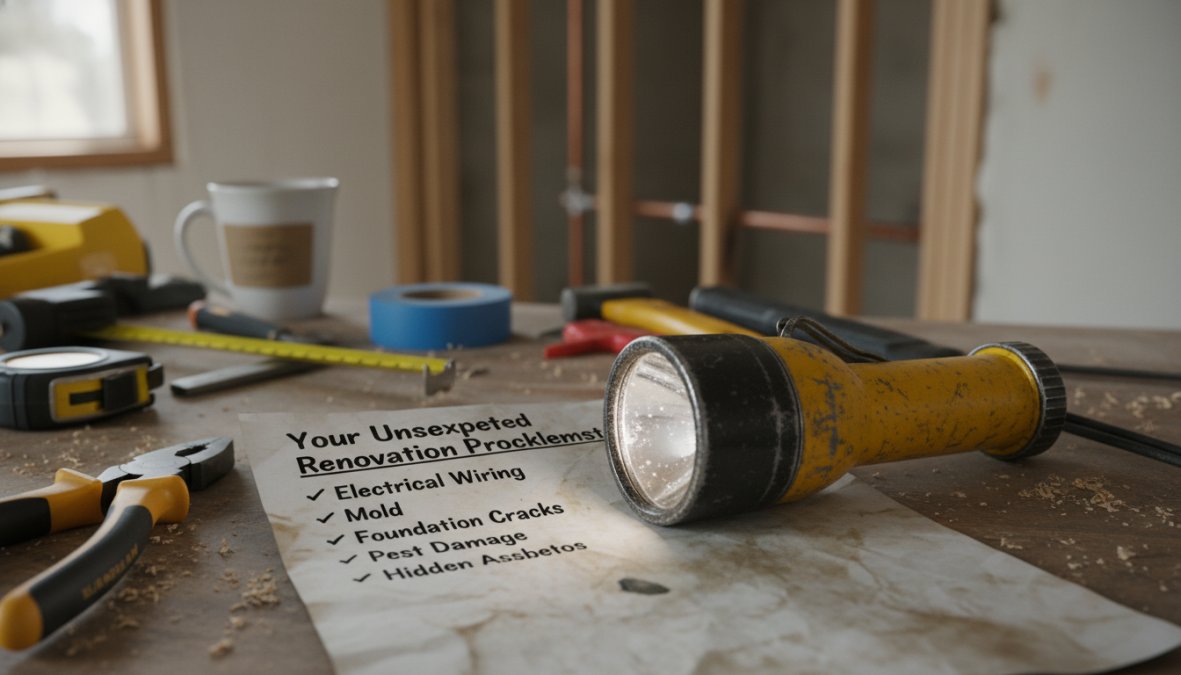
The most effective way to reduce renovation surprises is to anticipate them before demolition begins. This unexpected renovation problems checklist covers the categories that generate the largest unplanned costs.
Pre-construction risk assessment:
- Has the home been tested for asbestos (particularly in homes built before 1980)?
- Has lead paint testing been completed in areas where demolition will occur?
- Has the electrical panel capacity been evaluated relative to new load requirements?
- Has a plumber assessed the condition of existing supply and drain lines?
- Has the structural integrity of load-bearing walls been confirmed before any removal?
- Have HVAC ducts and equipment been inspected for condition and capacity?
- Has the foundation been inspected if the project involves significant structural changes?
- Have zoning laws and HOA restrictions been reviewed for compliance?
Structural, Plumbing, HVAC, and Electrical Surprises to Anticipate
The four mechanical and structural systems generate the majority of unexpected renovation costs. Understanding the risk profile of each helps you allocate contingency budget appropriately.
Structural: Load-bearing wall removal requires engineering review and often a structural beam installation. Many homeowners discover mid-project that a wall they planned to remove is load-bearing. Budget for a structural engineer consultation early.
Plumbing: Galvanized steel pipes common in pre-1970 homes corrode from the inside out. They may look functional until a wall is opened. Partial replumbing during a kitchen or bathroom remodel is far more cost-effective than addressing it after finishes are installed.
HVAC: Extending ductwork to a new room addition or reconfiguring for an open floor plan often reveals undersized equipment. A new HVAC layout may require a load calculation and equipment upgrade.
Electrical: Knob-and-tube wiring, aluminum branch circuit wiring, and undersized service panels are common in older Norwalk homes. Bringing electrical to current code during a remodel is often required by the permit, not optional.
Permits, Zoning Laws, and HOA Restrictions in Norwalk, CT
Permits and local regulations are an area where avoiding hidden costs home renovation requires local knowledge, not just general advice.
In Norwalk, building permits are required for structural work, electrical upgrades, plumbing modifications, HVAC installations, and additions. Skipping permits is a false economy. Unpermitted work creates problems at resale, can void homeowner’s insurance claims, and may require demolition and reconstruction to bring into compliance.
Zoning laws in Norwalk govern setbacks, lot coverage, and building height. A deck addition or garage conversion that seems straightforward may conflict with zoning requirements for your specific parcel. The Norwalk Building Department is the authoritative source for permit requirements and zoning compliance.
HOA restrictions add another layer. Many Norwalk neighborhoods with active homeowner associations have architectural review requirements that must be satisfied before exterior work begins. Submitting for HOA approval after starting work is a common and expensive mistake.
A design-build firm or general contractor with established relationships in Norwalk will know which projects trigger which requirements. This local knowledge has real dollar value.
Avoiding Hidden Costs Through Smart Material Selection and Eco-Friendly Sourcing
Material selection is where renovation budgets quietly expand. The initial bid often uses allowance figures for finishes, and homeowners consistently exceed those allowances once they start shopping.
The practical approach: lock in material specifications before the contract is signed, not after. When you select tile, cabinetry, fixtures, and hardware before the scope of work is finalized, the contractor can price actual materials rather than allowances.
Eco-friendly and sustainable materials are worth evaluating not just on environmental grounds but on total cost of ownership. Reclaimed wood flooring, low-VOC paints, and energy-efficient windows often carry higher upfront costs but reduce long-term maintenance and utility expenses. For Norwalk homeowners, Connecticut’s energy efficiency programs through Energize CT’s home improvement rebates may offset the premium on certain sustainable upgrades.
A common mistake is chasing the lowest material price without accounting for installation complexity. Some budget materials require more labor hours to install correctly, eliminating the savings on the material side.
Tony’s Home Improvement LLC approaches material sourcing with an emphasis on economical procurement without sacrificing quality, helping Norwalk clients find the right balance between upfront cost and long-term performance.
Digital Tools for Tracking Progress and Managing the Scope of Work
Project management tools have become genuinely useful for homeowners who want to stay on top of a renovation without micromanaging their contractor.
The most practical options:
- Buildertrend or CoConstruct: Contractor-facing platforms that also give homeowners visibility into schedules, change orders, and daily logs. Ask your contractor if they use either.
- Houzz Pro: Combines design inspiration with project management features useful for tracking material selections and approvals.
- Google Sheets or Notion: Simple but effective for tracking your own budget against actuals, logging change orders, and maintaining a communication record.
- Loom or similar video tools: Recording short walkthroughs of progress concerns creates a timestamped record that’s more useful than text descriptions in dispute situations.
The most important digital tool is a simple shared document that logs every verbal conversation with your contractor and confirms it in writing. "Per our conversation today, we agreed to…" followed by the specifics creates an audit trail that protects both parties.
Avoiding hidden costs home renovation is fundamentally a documentation and communication problem. The homeowners who stay on budget are almost always the ones who put everything in writing, review change orders before approving them, and check the project budget weekly rather than monthly.
The Psychological Impact of Remodeling and How to Stay in Control
Nearly every guide on avoiding hidden costs home renovation focuses on contracts, permits, and contractor vetting. Almost none of them address the mechanism that causes financially disciplined homeowners to blow their budgets anyway: the psychological pressure of living through a renovation erodes the decision-making quality that made the original plan sound.
This section covers what most guides skip entirely, and it may be the most practically useful part of this article.
Renovation Fatigue Is a Real Budget Risk
Renovation fatigue is the cumulative mental and emotional exhaustion that sets in when a project extends beyond four to six weeks, particularly when the homeowner is living in or adjacent to the construction zone. It is not a personality weakness. It is a predictable response to a sustained high-stress environment, and it has direct financial consequences.
The pattern looks like this: a homeowner who carefully reviewed every change order in week two starts approving them verbally by week seven because they are too tired to read another document. A homeowner who committed to a specific tile in the contract starts reconsidering it at week five because the disruption has made them question every earlier decision. A homeowner who planned to stay in budget authorizes a premium upgrade they didn’t originally want because the project has been so difficult that the upgrade feels like compensation.
Each of these is a rational response to an irrational situation. None of them are good financial decisions. And all of them are predictable if you know to watch for them.
The Three Psychological Mechanisms That Drive Budget Overruns
1. Decision fatigue and approval drift
Every renovation requires dozens of decisions, materials, finishes, sequencing, substitutions, change orders. Decision quality degrades as the number of decisions accumulates. By the midpoint of a major renovation, homeowners are making choices with less cognitive bandwidth than they had at the start. Contractors who present change orders late in the day, at the end of a difficult week, or immediately after a problem has been discovered are, whether intentionally or not, presenting them at the moment of lowest homeowner resistance.
The countermeasure: Establish a rule that no change order over a defined dollar threshold (e.g., $500) will be approved on the same day it is presented. Give yourself 24 hours and review it against your original project goals, not against the stress of the current moment.
2. Sunk cost escalation
Once a homeowner has spent $40,000 on a renovation, spending an additional $8,000 on an upgrade feels proportionally smaller than it would have before the project started. This is the sunk cost effect applied to home improvement: the money already spent makes new spending feel more justified, even when the new spending wasn’t in the plan and doesn’t improve the project’s core outcome.
This mechanism is particularly active when a project has already encountered problems. A homeowner who has absorbed a $6,000 unexpected plumbing cost is psychologically primed to approve a $3,500 countertop upgrade they previously declined, because the project has already "gone over" and the upgrade feels like a smaller additional deviation.
The countermeasure: Evaluate every change order against the original budget, not against the current running total. The question is not "is this reasonable given what we’ve already spent?" The question is "would I have approved this in week one?"
3. Scope creep driven by proximity
When walls are open and systems are exposed, homeowners see things they didn’t know existed and make decisions based on what’s visible rather than what was planned. This is proximity-driven scope creep: the renovation reveals the home’s infrastructure, and the homeowner starts optimizing infrastructure that wasn’t part of the original project.
Some of this is legitimate, if a plumber opens a wall and finds a failing pipe, addressing it is prudent. But much of it is opportunistic expansion that adds cost without proportional value. "While you’re in there, can you also…" is the most expensive phrase in residential renovation.
The countermeasure: Before the project starts, define a written list of what is explicitly out of scope for this renovation. When a "while you’re in there" opportunity arises, check it against the out-of-scope list before discussing it with your contractor.
Practical Strategies for Managing the Emotional Arc of a Renovation
Establish a daily communication rhythm before work begins, not after a problem arises.
Agree with your contractor on a specific daily or every-other-day update format, a brief text summary, a photo log, or a five-minute end-of-day call. The format matters less than the consistency. Homeowners who receive regular updates experience significantly less anxiety than those who have to chase information, and less anxiety means better decisions.
Create a decision log and stop revisiting closed decisions.
For every significant material or design decision, record the date, the options considered, and the reason for the choice. When renovation fatigue sets in and you start second-guessing week-two decisions in week six, the log provides an objective record of your reasoning when you were thinking clearly. Treat logged decisions as closed unless there is a structural reason to reopen them, not an aesthetic preference that emerged after a difficult week.
Plan your living situation before demolition, not during it.
If the renovation affects a kitchen, plan your alternative cooking and eating arrangements in advance. If it affects a bathroom, confirm the logistics of the remaining bathroom or a temporary solution before work starts. Homeowners who are improvising their daily routines under construction pressure make worse project decisions than homeowners who have a functioning, if temporary, domestic routine.
Define your "locked" decisions list.
Identify three to five decisions that are final before the project starts, the ones you will not revisit regardless of what you see in a showroom or on a design website during the renovation. These are typically the highest-cost items: cabinetry, countertops, flooring, and major fixtures. Locking these decisions in writing, and sharing that list with your contractor, removes them from the daily decision load and eliminates the most common entry points for scope creep.
If you are living in the home during a major renovation, budget for at least two or three nights away from the property at the midpoint of the project. The psychological reset of sleeping in a quiet, functional space has a measurable effect on decision quality when you return. This is not a luxury; it is a budget-protection strategy.
The Financial ROI of Emotional Discipline
A renovation that finishes at the original budget with slightly less premium finishes almost always delivers better financial outcomes than a renovation that delivers premium finishes at 25-30% over budget. The overage on the second project doesn’t appear in the home’s appraised value at a one-to-one ratio, the financing cost of the overage compounds over time, and the stress of the overrun affects the homeowner’s relationship with the finished space.
The homeowners who stay on budget through a difficult renovation are not the ones who had easier projects. They are the ones who recognized that their decision-making was under pressure and built systems, written decisions, cooling-off periods, locked scope lists, that protected their original plan from their future, fatigued selves.
Avoiding hidden costs home renovation is partly a contracting problem and partly a human problem. Addressing both is what separates a renovation that finishes as planned from one that becomes a cautionary story.
Frequently Asked Questions
What are the most common hidden costs in home renovations?
The most common hidden costs in home renovation include unforeseen structural issues discovered during demolition, outdated plumbing or electrical systems that must be brought up to code, permit fees not included in the original quote, and material price fluctuations. Avoiding hidden costs in home renovation requires a detailed scope of work upfront, a contingency budget, and a thorough site inspection before work begins. Always ask your general contractor to walk through potential problem areas before signing a construction contract.
How much extra should I budget as a home renovation contingency?
A home renovation contingency budget of 10% to 20% of your total project cost is generally recommended. For older homes or complex custom renovation projects involving HVAC, plumbing, or electrical upgrades, lean toward 20%. For newer homes with straightforward cosmetic updates, 10% may suffice. This reserve covers change orders, unforeseen costs, and material selection adjustments mid-project. Setting this aside before work starts prevents financial stress and keeps your renovation timeline on track.
What contract clauses should homeowners insist on to avoid extra costs?
Key renovation contract clauses to protect homeowners include a clearly defined scope of work, a detailed payment schedule tied to project milestones, a written change order process requiring your approval before any additional costs are incurred, a warranty clause covering both labor and materials, and a clause addressing unforeseen costs and how they will be communicated. Also confirm that building permits, subcontractors, and liability insurance are explicitly covered in the agreement.
Are building permit fees usually included in renovation quotes?
Not always, this is one of the most common sources of surprise charges. Building permits and associated zoning law compliance fees are sometimes listed separately or omitted entirely from initial renovation quotes. Before signing any construction contract, ask your general contractor to itemize whether permit fees are included. In Norwalk, CT, permit requirements vary by project type and scope, so clarifying this early is essential to avoiding hidden costs in home renovation.
What questions should I ask a contractor before starting a renovation?
Before hiring a general contractor, ask: Are you licensed and insured, including workers compensation and liability insurance? Can you provide references and past client testimonials? How do you handle change orders and unforeseen costs? What does the payment schedule look like? Who are your subcontractors and how are they vetted? Will you pull all required building permits? How will we communicate throughout the project? These questions to ask a contractor before renovation help you assess professionalism and protect your renovation budget.
This article was written using GrandRanker
 Tony's Home Improvement LLC
Leave a comment