
Table of Contents
- What General Contractor Services Actually Cover
- Managing Construction Subcontractors: Roles, Risks, and Best Practices
- General Contractor Cost Breakdown: How Pricing Really Works
- Permitting, Building Codes, and Legal Compliance
- The Project Management Process from Start to Final Walkthrough
- Questions to Ask a General Contractor Before You Hire
- Why Tony’s Home Improvement LLC Stands Out for General Contractor Services
- Conclusion
Last Updated: May 20, 2026
Choosing the right contractor can be the difference between a project that runs smoothly and one that drains your budget, tests your patience, and leaves you with substandard work. General contractor services cover far more ground than most homeowners and business owners realize, and understanding exactly what that scope includes is the fastest way to protect yourself before signing anything. Tony’s Home Improvement LLC has helped clients across residential and commercial projects navigate this process, and this guide breaks down everything you need to know: from how pricing actually works to what questions separate a trustworthy contractor from a costly mistake.
Here’s what most guides get wrong: they treat general contractor services as a simple list of tasks. The reality is that a general contractor is a project architect, a supply chain manager, a compliance officer, and a quality controller rolled into one. Get that wrong, and every other decision you make downstream gets harder.
Below, we’ll cover the full scope of contractor services, how subcontractor relationships work, how to read a cost breakdown, what permitting actually involves, and the exact questions you should ask before handing over a deposit.
What General Contractor Services Actually Cover
A general contractor is the single point of accountability on a construction or renovation project. General contractor services encompass planning, procurement, subcontractor coordination, code compliance, and delivery of the finished project to the client’s specifications. This is not a trade role. A GC does not typically swing a hammer; they manage the people who do.
 construction site with timber framing visible in the background, morning light casting long shadows across the worksite](https://cdn.grandranker.com/articles/general-contractor-services-a-complete-2026-guide-content-1-1779241644.jpg)
The scope typically includes:
- Pre-construction planning and site assessment
- Budget development and material sourcing
- Permitting and code compliance management
- Subcontractor hiring, scheduling, and oversight
- Quality control at each project phase
- Client communication and progress reporting
- Final walkthrough and punch list resolution
What separates a strong GC from a weak one is not the list above. Every contractor claims to do all of it. The difference is execution: how tightly they manage subcontractor schedules, how proactively they communicate cost changes, and how rigorously they enforce building codes before an inspector shows up.
Residential Construction and Remodeling
Residential general contractor services span new construction, full-gut renovations, kitchen and bathroom remodels, additions, waterproofing, concrete restoration, and cosmetic updates. The complexity varies enormously. A bathroom tile replacement is a two-day job. A full kitchen remodel involving structural changes, plumbing relocation, and custom cabinetry can run eight to twelve weeks.
Residential projects often involve HOA restrictions, especially in planned communities across Central Florida and similar markets. A qualified GC will review HOA guidelines before work begins and incorporate any design or material restrictions into the project scope. Ignoring this step leads to costly rework.
Commercial Construction and Interior Fit-Outs
Commercial general contractor services add layers of regulatory complexity that residential work does not carry. Interior fit-outs for office spaces, retail environments, and multi-unit properties must comply with NEPA guidelines, ADA accessibility requirements, and commercial building codes that differ significantly from residential standards.
Design-build delivery is increasingly common in commercial work. Under this model, the GC manages both architectural design and construction under a single contract, which reduces the coordination gap between designer and builder. According to the Design-Build Institute of America’s project delivery research, design-build projects consistently outperform traditional delivery methods on speed and cost certainty.
Managing Construction Subcontractors: Roles, Risks, and Best Practices
Most people assume the general contractor does the physical work. That assumption leads to confusion when something goes wrong on site.
Managing construction subcontractors is one of the most critical functions a GC performs. On any mid-size project, a GC coordinates electricians, plumbers, HVAC technicians, framers, drywall crews, painters, and specialty trades, often simultaneously. Each subcontractor operates under a separate contract with the GC, not with the property owner.
Contractor vs. Subcontractor: Who Is Responsible for What
The general contractor holds primary legal and financial responsibility to the client. Subcontractors are responsible to the GC for their specific scope of work. This distinction matters enormously when defects or delays occur.
Here is the practical breakdown:
| Role | Contract With | Responsible For | Licensed By |
|---|---|---|---|
| General Contractor | Property Owner | Full project delivery | State licensing board |
| Subcontractor | General Contractor | Specific trade scope | Trade-specific license |
| Specialty Sub | General Contractor | Niche work (waterproofing, etc.) | Specialty certification |
A common mistake homeowners make is negotiating directly with subcontractors to cut costs. This breaks the chain of accountability. If the plumber causes water damage and you paid them directly, your recourse against the GC is significantly weakened.
Never pay subcontractors directly unless your contract with the GC explicitly authorizes it and you have documented lien waivers from each trade. Without lien waivers, a subcontractor who was paid by the GC can still place a mechanic’s lien on your property if the GC fails to pay them.
The GC’s job is to vet subcontractors for licensing, insurance, and workmanship quality before they ever set foot on your site. Ask your GC for proof of subcontractor insurance certificates before work begins.
General Contractor Cost Breakdown: How Pricing Really Works
The general contractor cost breakdown is where most disputes originate. Clients often receive a final invoice that looks nothing like the original estimate, and without understanding the pricing model, they have no framework to evaluate whether the charges are legitimate.
Understanding the general contractor cost breakdown before you sign a contract is non-negotiable.
Common Pricing Models Explained
Three pricing models dominate the industry:
Fixed-Price (Lump Sum): The GC commits to a total price for a defined scope. This protects the client from cost overruns but typically includes a contingency buffer built into the GC’s price. Best for projects with a well-defined scope.
Cost-Plus: The client pays actual costs (labor, materials, subcontractors) plus a GC fee, either as a flat amount or a percentage of total costs. More transparent but exposes the client to budget risk if scope is not tightly managed.
Guaranteed Maximum Price (GMP): A hybrid model where the GC commits to a cost ceiling. Any savings below the maximum are typically shared between client and contractor. Common on larger commercial projects.
For residential remodels, request a fixed-price contract with a clearly defined change order process. Change orders should require written approval and a cost estimate before any out-of-scope work begins. Verbal approvals are how budgets spiral.
What Drives Labor Costs and Construction Materials Expenses
Labor costs and construction materials expenses are the two largest line items in any project budget. Labor pricing varies by trade, region, and current market demand. Material costs fluctuate based on supply chain conditions and project timing.
What most clients do not realize is that experienced GCs have established supplier relationships that reduce construction materials costs below retail pricing. Tony’s Home Improvement LLC, for example, sources materials economically through vetted supplier networks, passing those savings to clients rather than padding margins.
The GC markup, typically applied to both labor and materials, covers overhead, profit, and risk management. A transparent GC will break this out clearly in their proposal. If a contractor refuses to itemize their markup, treat that as a red flag.
Permitting, Building Codes, and Legal Compliance
Skipping permits is one of the most expensive mistakes a property owner can make. The permit process exists to protect occupants, not to create bureaucratic friction, and a licensed GC should manage it without requiring the client to chase paperwork.
According to the International Code Council’s building safety resources, unpermitted work can void homeowner’s insurance coverage, create title issues when selling a property, and require demolition of completed work if discovered during inspection.
Permitting requirements vary by jurisdiction, project type, and scope. Structural changes, electrical upgrades, plumbing modifications, and additions almost universally require permits. Cosmetic work like painting services or flooring replacement typically does not. A qualified GC will identify permit requirements during the pre-construction phase and factor permit timelines into the project schedule.
Building codes govern minimum safety standards for construction materials, structural integrity, fire resistance, and electrical systems. A GC who cuts corners on code compliance is not saving you money. They are transferring risk onto you. Licensed and insured contractors carry the financial protection mechanisms (liability insurance, bonding) that protect clients when code violations or accidents occur.
Always verify that your GC pulls permits in their name, not yours. When permits are pulled in the owner’s name, the owner assumes liability for code compliance. A professional GC takes on that responsibility as part of their service.
The Project Management Process from Start to Final Walkthrough
Strong project management is what separates a general contractor from a handyman with a truck. But knowing the phase names is not enough, what homeowners actually need is a map of the decision points where projects go wrong, and what a professional GC does at each one to prevent it.
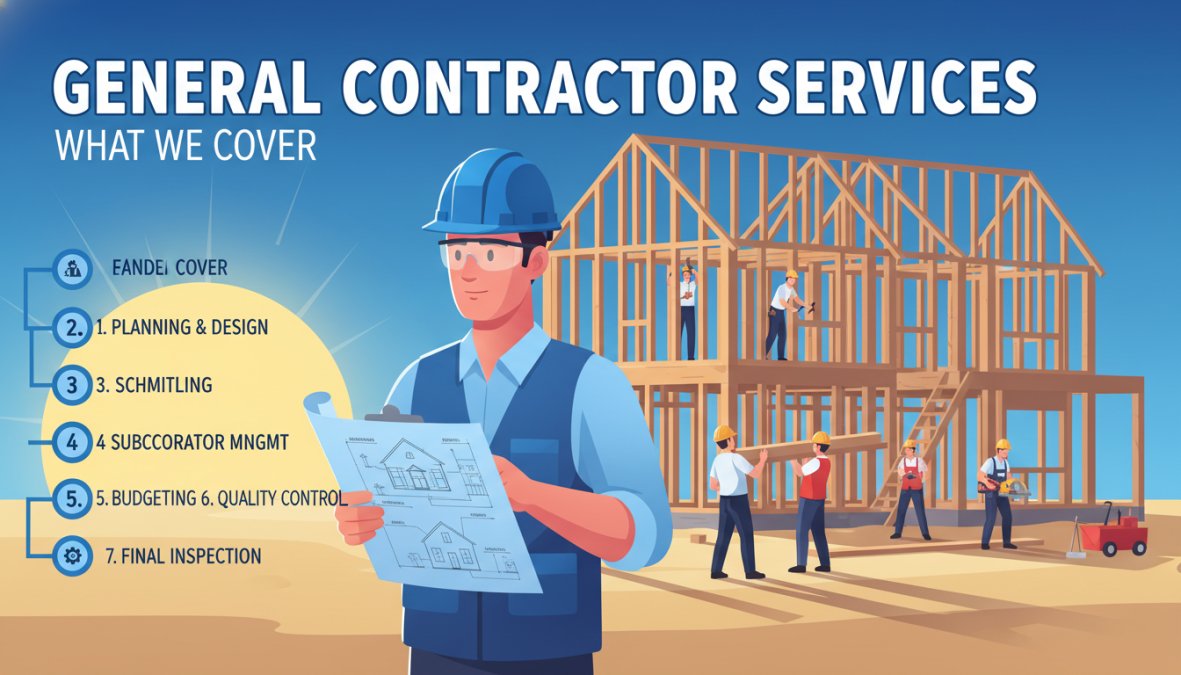
Phase 1: Pre-Construction, Where Most Projects Are Won or Lost
The pre-construction phase is the highest-leverage window in any project. Decisions made here, scope definition, budget contingency, permit sequencing, subcontractor selection, determine whether the construction phase runs smoothly or becomes a daily crisis.
A professional GC will produce a written scope of work before any contract is signed. This document should specify materials by grade or product line, not just category. "Tile flooring" is not a scope item. "12×24 porcelain tile, Grade 1, installed with large-format setting mortar" is a scope item. Vague scope language is the single most common source of change-order disputes.
Permit applications are filed during pre-construction, not after mobilization. In many jurisdictions, permit review takes two to six weeks for standard residential projects and longer for commercial work. A GC who waits until the crew is ready to start before filing permits is building schedule risk into your project from day one.
What to ask your GC at this phase:
- Can I see the written scope of work with material specifications before signing?
- When will permit applications be filed, and what is the expected review timeline for this jurisdiction?
- What contingency percentage is built into the budget, and what triggers a formal change order?
Phase 2: Mobilization, The Logistics Window Clients Rarely See
Mobilization covers site preparation, material procurement, temporary utility setup, and crew scheduling. It is largely invisible to the client, which is exactly why it deserves attention.
Material procurement timing matters more than most homeowners realize. Custom cabinetry, specialty tile, structural steel, and certain plumbing fixtures can carry lead times of four to twelve weeks depending on the supplier and current supply chain conditions. A GC who does not order long-lead items during pre-construction will hit a wall mid-project when the kitchen cabinets are not ready and the crew is standing idle, billing hours.
During mobilization, your GC should provide a master schedule showing each trade’s start and end dates, material delivery windows, and inspection milestones. This schedule is a living document, but having a baseline version gives both parties a reference point when delays occur.
Phase 3: Active Construction, Daily Accountability Mechanisms
The construction phase is where schedule discipline and communication protocols determine client experience. Professional GC firms use structured daily or weekly reporting to keep clients informed without requiring them to be on-site.
At a minimum, expect:
- A weekly written progress update covering work completed, work scheduled for the following week, any open issues, and current budget status relative to approved scope
- Documented photo logs at each milestone (framing inspection, rough-in inspection, insulation, drywall hang)
- Written change order requests with cost and schedule impact before any out-of-scope work begins
Platforms like Procore’s construction management software are used by larger GC firms to centralize documentation, track budgets in real time, and maintain field-to-office communication. For clients working with smaller contractors, ask specifically how they document daily progress and through what channel you will receive schedule change notifications.
If your contractor makes verbal change order requests, “We found a problem behind the wall, it’ll cost a bit more, I’ll add it to the final invoice”, stop the conversation and request a written change order with a cost estimate before approving any additional work. Verbal approvals are the mechanism by which residential budgets spiral 20-40% beyond original estimates.
Phase 4: Inspections, The GC’s Job, Not Yours
Building inspections are not optional checkpoints. They are legally required hold points in the construction sequence. Framing cannot be covered with drywall until the framing inspection passes. Electrical rough-in cannot be closed in until the electrical inspector signs off. A GC who skips inspections to save time is creating a liability that transfers to the property owner.
Your GC should schedule and attend all required inspections. You should receive copies of all inspection reports, passed and failed. A failed inspection is not automatically a red flag; inspectors sometimes flag minor items that are quickly corrected. What matters is that the GC resolves the issue and obtains a passing inspection before proceeding.
Phase 5: Substantial Completion and the Punch List
Substantial completion means the project is functional and usable, but a punch list of remaining items exists. The punch list is a written, itemized record of every deficiency, incomplete item, or correction needed before final payment is released.
A professional GC generates the punch list proactively rather than waiting for the client to find problems. Walk the project yourself with the original approved plans and scope of work in hand. Compare what was specified against what was delivered. Common punch list items include:
- Paint touch-ups at trim and door frames
- Caulk gaps at tile transitions or plumbing fixtures
- Hardware that was not installed or installed incorrectly
- Doors or windows that do not operate smoothly
- Grout haze on tile surfaces
- Missing cover plates on electrical outlets
Do not release final payment until every punch list item is resolved and you have signed off in writing. Retaining the final payment, typically 5-10% of the contract value, is the client’s primary leverage for ensuring punch list completion.
Phase 6: Final Walkthrough, Your Last Checkpoint Before Closeout
The final walkthrough is not a formality. It is the client’s last opportunity to identify deficiencies before releasing the final payment and triggering the workmanship warranty period.
Come prepared with:
- The original signed contract and scope of work
- All approved change orders
- The punch list from substantial completion
- A copy of the approved building plans
Verify that all permit inspections have received final sign-off and that the GC has provided you with copies of all closed permits. In most jurisdictions, the final permit card or certificate of occupancy is a legal document you will need when selling the property or filing an insurance claim related to the work.
Request a project closeout package from your GC at final walkthrough. This should include: copies of all permits and inspection reports, manufacturer warranty documents for installed equipment and materials, subcontractor contact information for warranty claims, and as-built drawings if any structural or MEP (mechanical, electrical, plumbing) changes were made during construction.
Questions to Ask a General Contractor Before You Hire
Most homeowners ask the wrong questions. They focus on price and timeline while ignoring the factors that actually predict project success.
Homeowner Vetting Checklist
Use this checklist before signing any contract:
- Is the contractor licensed in your state and can they provide their license number?
- Do they carry general liability insurance and workers’ compensation? Request certificates of insurance, not verbal confirmation.
- Can they provide references from three projects completed in the last 18 months of similar scope?
- Do they pull permits for all applicable work, and in whose name?
- How do they handle change orders? Is there a written process with cost approval before work proceeds?
- Who are their primary subcontractors, and are those subs licensed and insured?
- What is their payment schedule? (Avoid contractors who demand more than 30% upfront on residential projects.)
- Do they offer a written guarantee on their workmanship?
- How do they communicate progress? Weekly updates? Daily logs?
- Have they worked on projects subject to HOA approval or NEPA review?
The answers to these questions tell you more than a portfolio ever will. A contractor who hesitates on any of the insurance or permit questions is not someone you want managing your project.
According to the National Association of Home Builders’ contractor selection guidance, verifying license status and insurance before hiring is the single most important step homeowners can take to protect themselves from construction fraud.
Why Tony’s Home Improvement LLC Stands Out for General Contractor Services
The construction industry has no shortage of contractors who promise quality and deliver mediocrity. Rather than repeating the same four adjectives every competitor uses, this section does something most contractor websites will not: it gives you the specific, verifiable criteria you should use to evaluate any GC, including us, before signing a contract.
If Tony’s Home Improvement LLC is the right fit for your project, these criteria will show you why. If another contractor scores higher on your checklist, you should hire them. That is what a client-centered approach actually looks like.
What a Client-Centered GC Does Differently
Most contractor websites describe their process from the contractor’s perspective: what they build, how long they have been in business, how many projects they have completed. A client-centered approach inverts that framing. It starts with what the client needs to feel confident, informed, and protected, and builds the service model around those needs.
In practice, this means four operational commitments that show up in the contract and the project, not just in the marketing copy:
1. Transparent cost documentation from day one.
Tony’s Home Improvement LLC provides itemized proposals that separate labor, materials, subcontractor costs, and GC overhead. Clients can see exactly what they are paying for and why. When material costs change due to supply conditions, the change is documented in a written change order with a cost breakdown, not absorbed into a vague line item on the final invoice.
This matters because the most common source of contractor disputes is not poor workmanship, it is billing surprises. Clients who understand their cost breakdown before work begins are equipped to evaluate whether a change order is legitimate or inflated.
2. Permit management handled entirely by the GC.
All permits on Tony’s Home Improvement LLC projects are pulled in the company’s name, not the property owner’s name. This is not a minor administrative detail. When permits are pulled in the owner’s name, the owner assumes legal liability for code compliance. A licensed GC who pulls permits in their own name is putting their license on the line, which is the correct alignment of accountability.
3. Verified subcontractor network.
Every subcontractor working on a Tony’s Home Improvement LLC project carries current general liability insurance and holds the trade-specific license required by Florida state law. Clients can request subcontractor insurance certificates before work begins. This is standard practice for professional GC firms and should be standard practice for any contractor you hire.
4. Structured communication protocol.
Clients receive written project updates on a defined schedule, not when the contractor gets around to it. Schedule changes, material delays, and scope questions are communicated before they become problems. This is the single most cited complaint in residential construction: homeowners feel uninformed and have to chase their contractor for basic status updates. Treating communication as a deliverable, not an afterthought, is the operational difference between a professional firm and a transactional one.
How to Verify These Claims Before You Hire Anyone
Do not take any contractor’s word for the commitments above. Verify them with these specific requests during your initial consultation:
Pre-Hire Verification Checklist
- Ask to see a sample proposal from a completed project of similar scope. Does it itemize labor, materials, and markup separately, or is it a single lump-sum number?
- Ask who pulls the permits and in whose name. Request to see a copy of a permit from a recent project.
- Ask for the names of two or three subcontractors they regularly use and request proof of insurance for each.
- Ask how you will receive project updates and how quickly they respond to client questions. Request a sample progress report from a past project.
- Ask for three client references from projects completed in the last 18 months of similar scope and budget. Call them. Ask specifically about communication, budget accuracy, and how the contractor handled unexpected problems.
A contractor who is confident in their process will answer every one of these questions without hesitation and provide documentation on request. Hesitation, deflection, or vague answers on any of the insurance, permit, or communication questions are meaningful signals.
The Scope of Work Tony’s Home Improvement LLC Handles
Tony’s Home Improvement LLC delivers general contractor services across both residential and commercial properties throughout the service area, including:
- Kitchen and bathroom remodels, from cosmetic updates to full structural renovations
- Room additions and whole-home renovations
- Concrete restoration and waterproofing
- Commercial interior fit-outs and tenant improvements
- Design-build project delivery for clients who want a single point of contact from concept through construction
- Structural repairs and custom renovation work
For homeowners and business owners ready to move forward, a free estimate is the right first step. Come to that conversation with your checklist. We expect it.
The best indicator of a trustworthy general contractor is not their portfolio, it is how they respond when you ask hard questions about permits, insurance, subcontractors, and billing. A professional GC welcomes those questions. Tony’s Home Improvement LLC is built to answer all of them.
Frequently Asked Questions
What exactly does a general contractor do?
A general contractor oversees every phase of a construction or renovation project. They handle budget estimation, hire and manage subcontractors, source construction materials, pull permits, and ensure work meets building codes. On residential and commercial projects alike, the GC serves as the single point of accountability, coordinating schedules, managing labor costs, and conducting a final walkthrough to confirm everything meets the agreed project scope before handing the keys back to you.
How do general contractors charge for their services?
A general contractor cost breakdown typically falls into three models: a fixed lump-sum price for well-defined scopes, a cost-plus arrangement where you pay actual costs plus a contractor fee, or a time-and-materials rate for smaller or unpredictable jobs. Labor costs and construction materials usually make up the largest share. Always request an itemized written estimate so you can compare bids accurately and verify cost transparency before signing any contract.
What is the difference between a general contractor and a subcontractor?
A general contractor holds the primary contract with you and is legally responsible for the entire project, including safety standards and permitting. Subcontractors are specialists, electricians, plumbers, painters, waterproofing crews, hired by the GC to complete specific scopes of work. The GC manages all subcontractor scheduling, quality control, and payments. As the homeowner, your financial protection and legal recourse run through the licensed and insured general contractor, not the individual subs.
What questions should I ask a general contractor before hiring?
Key questions to ask a general contractor include: Are you licensed and insured in this state? Can you provide a written guarantee on workmanship? How do you handle permitting and building codes? Who are your subcontractors and how do you vet them? What does your project management process look like from start to final walkthrough? Can you provide references from similar residential or commercial construction projects? And will you provide an itemized cost breakdown before work begins?
When do you need to hire a general contractor?
You should hire a general contractor any time a project involves multiple trades, structural changes, new construction, or work that requires permits. Kitchen and bathroom remodels, additions, design-build renovations, commercial interior fit-outs, and concrete restoration projects all typically require a GC. For minor cosmetic updates, like painting services or small repairs, a specialty contractor may suffice, but for anything touching structure, electrical, or plumbing, a licensed and insured GC is strongly recommended.
This article was written using GrandRanker
 Tony's Home Improvement LLC
Leave a comment