Table of Contents
- Best Bathroom Vanity Countertop Materials: A Full Comparison
- Solid Wood vs MDF Bathroom Vanity: Which Cabinet Material Wins?
- Durability, Moisture Resistance, and Scratch Resistance Compared
- How to Maintain Bathroom Vanity Materials the Right Way
- Cost Comparison: What Each Bathroom Vanity Material Will Cost You
- Sustainability and Eco-Friendly Vanity Material Options
- Climate-Specific Recommendations for the Best Bathroom Vanity Materials
- Conclusion: Choosing the Right Vanity Material for Your Remodel
Last Updated: May 25, 2026
Choosing the wrong vanity material is one of the most expensive mistakes in a bathroom remodel, and it happens far more often than it should. This best bathroom vanity materials comparison guide covers every major option available in 2026, from engineered quartz to solid wood, so you can make a decision you won’t regret in five years. Tony’s Home Improvement LLC has helped homeowners navigate exactly these choices across hundreds of bathroom remodels, and the patterns are clear: the wrong material in the wrong environment causes premature failure, costly repairs, and buyer’s remorse. Below, we’ll show you exactly how each material performs across durability, moisture resistance, maintenance, cost, and sustainability, including two angles most guides completely ignore: repairability and climate-specific suitability.
Here’s what most guides get wrong: they treat vanity material selection as purely aesthetic. The real decision is environmental. A material that thrives in a dry Arizona climate can warp and delaminate in a humid Florida bathroom within two years.
Best Bathroom Vanity Countertop Materials: A Full Comparison
Bathroom vanity countertop materials fall into three broad categories: engineered stone surfaces (quartz, solid surface), natural stone (granite, marble), and budget-oriented options (laminate, porcelain slab). Each category carries fundamentally different trade-offs in porosity, sealing requirements, scratch resistance, and long-term cost of ownership.
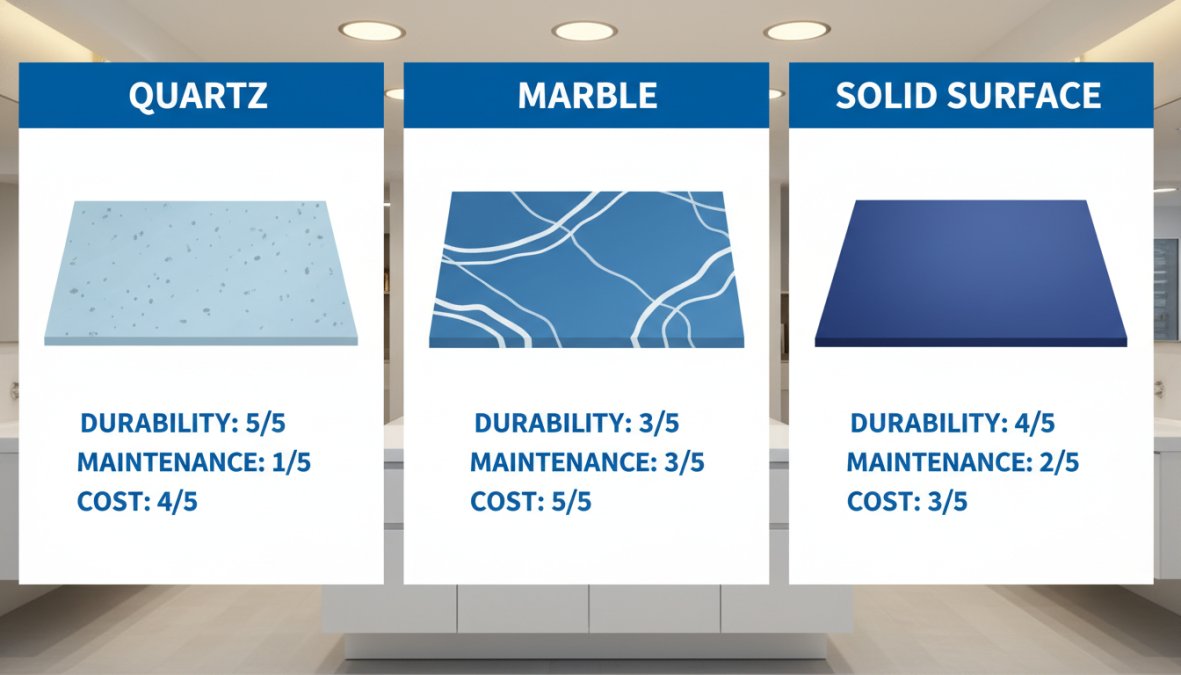
| Material | Porosity | Sealing Required | Durability | Relative Cost | Best For |
|---|---|---|---|---|---|
| Quartz | Non-porous | No | Very High | Mid-High | Low-maintenance, high-traffic |
| Granite | Porous | Yes (annual) | High | Mid-High | Unique aesthetics, heat resistance |
| Marble | Porous | Yes (frequent) | Moderate | High | Luxury look, low-humidity baths |
| Solid Surface | Non-porous | No | Moderate | Mid | Seamless look, repairability |
| Cultured Marble | Low-porous | No | Moderate | Low-Mid | Budget-conscious upgrades |
| Laminate | Low-porous | No | Low-Moderate | Low | Budget remodels |
| Porcelain Slab | Non-porous | No | Very High | Mid | Modern aesthetic, durability |
Quartz (Engineered Stone): The Low-Maintenance Powerhouse
Quartz is the most practical choice for most bathroom vanity countertops in 2026. Engineered stone is a manufactured surface composed of roughly 90-95% ground natural quartz bound with acrylic resin and pigments, resulting in a non-porous, non-absorbent surface that resists bacteria growth without any sealing.
Brands like Cambria and Silestone (by Cosentino) and MSI’s Q Quartz line dominate this segment. Cambria, in particular, produces its quartz entirely in the USA and requires zero sealing, polishing, or reconditioning. MSI offers a more budget-accessible entry point with an extensive color and pattern selection suitable for both residential and commercial countertop installation projects.
Pros:
- Non-porous: no bacteria growth, no sealing required
- Consistent color and pattern across the full slab (no seam visibility surprises)
- Excellent scratch resistance and stain resistance
- Mimics natural stone aesthetics without the maintenance burden
Cons:
- Heat resistance is lower than granite; direct heat exposure can damage the resin binders
- Premium brands carry a premium price
- Not repairable if chipped (replacement is the only real option for deep damage)
If you’re choosing between quartz brands, opt for a full-slab option over tile-format quartz. Full slabs eliminate grout lines where moisture and bacteria accumulate, which matters more in a bathroom than in a kitchen.
Natural Stone: Granite and Marble
Natural stone is the most visually distinctive option and the one most likely to create regret if chosen without understanding its maintenance demands. Granite is a porous igneous rock that requires annual sealing to prevent stain absorption and bacterial infiltration. Marble is even more porous and considerably softer, making it vulnerable to etching from common bathroom products like toothpaste and certain cleansers.
That said, granite offers genuinely superior heat resistance compared to any engineered alternative, and no two slabs are identical. For homeowners who value a unique aesthetic and are willing to commit to a sealing schedule, granite remains a compelling choice. Marble is best reserved for powder rooms or low-humidity bathrooms where moisture exposure is minimal and the visual payoff justifies the upkeep.
Pros:
- Unique, one-of-a-kind appearance
- Granite’s heat resistance is unmatched
- High perceived luxury value
Cons:
- Requires regular sealing (granite annually; marble more frequently)
- Marble etches easily from acidic substances
- Higher risk of staining in high-traffic bathrooms
Solid Surface and Cultured Marble
Solid surface materials, most famously represented by Corian (by DuPont), are manufactured from acrylic resin and mineral dust. The result is a non-porous, seamless surface that can be fabricated with integrated sinks, eliminating the crevice between the vanity top and the bowl where mold and bacteria typically accumulate.
Cultured marble is a different product: a composite of crushed marble and polyester resin coated with a gel finish. It’s non-porous at the surface level but can chip to reveal the porous substrate underneath. Wolf Home Products offers both solid surface and cultured marble tops at accessible price points, pre-drilled for standard faucet installation.
The defining advantage of solid surface is repairability. Surface scratches and minor burns can be sanded out and refinished, which is something no other countertop material category offers.
Budget-Friendly Options: Laminate and Porcelain Slab
Laminate, associated with brands like Formica, has improved significantly and deserves more credit than it typically receives. Modern laminate vanity tops resist moisture reasonably well at the surface, but the substrate (usually MDF or particle board) is highly vulnerable to water absorption at exposed edges and seams. Swelling and delamination at the backsplash joint is the most common failure mode.
Porcelain slab is the budget-friendly option that actually performs like a premium material. It’s non-porous, scratch-resistant, and heat-resistant, with large-format slabs eliminating most seam visibility concerns. According to The Tile Council of North America’s installation guidelines, large-format porcelain requires careful substrate preparation to prevent cracking, but once installed correctly, it rivals quartz in long-term durability at a lower material cost.
Solid Wood vs MDF Bathroom Vanity: Which Cabinet Material Wins?
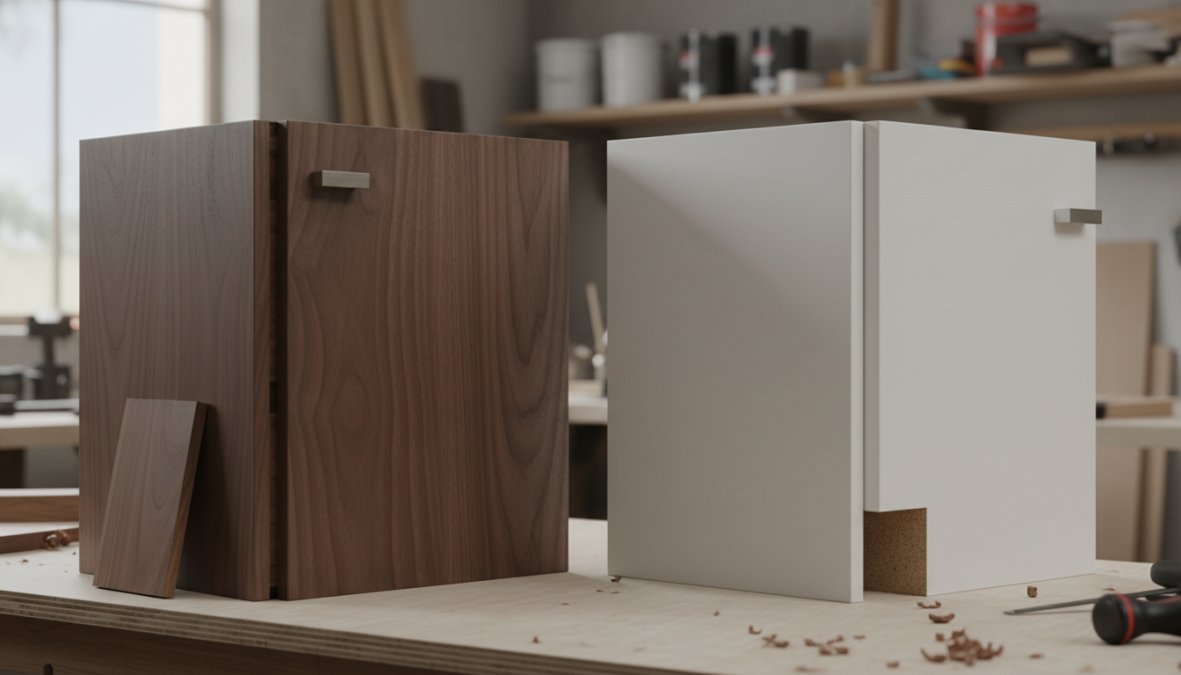
The vanity cabinet material matters as much as the countertop, yet it gets a fraction of the attention. The solid wood vs MDF bathroom vanity debate comes down to one primary variable: how much humidity does your bathroom generate? The answer should drive the decision more than aesthetics or price. But most guides stop at ‘MDF is bad with water’ without explaining the actual failure mechanism, the humidity thresholds that trigger it, or what construction details can extend the life of a lower-cost cabinet in a challenging environment.
How Moisture Actually Destroys Cabinet Materials: The Mechanism
Understanding why materials fail, not just that they fail, is what allows you to make a smarter purchase and take preventive steps.
MDF failure mechanism: MDF is manufactured by breaking wood fiber down to individual strands and bonding them under heat and pressure with urea-formaldehyde or similar resin binders. The resulting panel has no grain direction and no natural moisture-shedding structure. When water vapor or liquid water contacts unfinished or compromised MDF edges, the resin bonds weaken and the wood fibers swell outward. This swelling is irreversible, the fibers do not return to their original position when dried. A cabinet box that has swollen at the toe kick or bottom shelf cannot be restored; it must be replaced. The typical failure timeline in a bathroom with no exhaust fan and daily shower use is 5-8 years for the cabinet box, often starting at the bottom corners where condensation pools.
Particle board failure mechanism: Particle board uses larger wood chips and a higher proportion of binder, making it even more porous than MDF and significantly heavier per panel. It absorbs moisture faster and swells more dramatically. Particle board is the material most likely to be found in imported vanities at the lowest price tier. In a high-humidity bathroom, particle board cabinet boxes can begin showing structural failure, drawer slides pulling loose, doors going out of square, within 3-5 years.
Plywood failure mechanism (or lack thereof): Plywood’s cross-laminated layer structure means moisture absorption is resisted by alternating grain directions. Even when a plywood panel absorbs surface moisture, the structural integrity of the panel is largely maintained because the layers work against each other’s expansion. This is why plywood is the preferred substrate for marine and exterior applications, the same physics apply in a bathroom. Plywood can still fail if water consistently contacts unfinished edges or if a plumbing leak saturates the panel over weeks, but its failure timeline in normal bathroom conditions is measured in decades, not years.
Solid wood failure mechanism: Solid wood is the most nuanced. Properly finished solid hardwood (maple, oak, cherry) resists moisture well at the surface, but solid wood panels move seasonally as humidity fluctuates. In a bathroom that swings between very dry (winter heating) and very humid (daily showers), solid wood door panels can warp, cup, or develop finish cracks at joints over time. This is why quality manufacturers like Strasser Woodenworks and James Martin Vanities use solid wood for face frames and door frames but often use plywood for cabinet box panels, combining the aesthetic of real wood with the dimensional stability of plywood where it matters most.
Solid Wood and Plywood: Durability and Moisture Resistance
Solid wood and plywood cabinet construction represent the most durable long-term option for bathroom vanities, but the construction details matter as much as the material choice.
Solid hardwoods like maple, oak, and cherry (used by manufacturers such as Strasser Woodenworks and James Martin Vanities) offer genuine structural integrity, with dovetail drawer joinery that holds up to decades of daily use. The dovetail joint is not a marketing feature, it is a mechanical interlock that resists the racking forces applied every time a drawer is opened under load. Stapled or doweled drawer boxes, common in lower-cost construction, rely entirely on adhesive and fastener holding strength, which degrades with moisture cycling.
Plywood is actually superior to solid wood for panel construction in bathrooms. Its cross-laminated structure resists warping and seasonal movement better than solid wood panels, making it the preferred substrate for high-quality cabinet boxes. Water Creation uses solid wood construction on many of its models, offering a good balance between build quality and accessible pricing.
The honest limitation: even solid wood and plywood will fail if water consistently reaches unfinished surfaces. All interior cabinet surfaces, including the inside of the cabinet box, the underside of shelves, and the interior of the toe kick, should be finished or sealed. Many production vanities leave interior surfaces raw, which is acceptable for plywood but a meaningful risk for MDF.
Never install a vanity cabinet with an unfinished interior in a bathroom that lacks adequate ventilation. Water vapor alone, over months, will cause the cabinet box to swell and the finish to bubble, regardless of whether it’s solid wood or plywood. The EPA recommends bathroom exhaust fans sized to achieve a minimum of 8 air changes per hour, for most bathrooms, this means a fan rated at 50-110 CFM depending on room volume.
MDF and Particle Board: Cost vs. Performance
MDF (medium-density fiberboard) is the dominant material in mid-range vanity cabinets, and it has a legitimate place in the market. MDF machines cleanly, holds paint exceptionally well, and produces a smooth, furniture-grade appearance at a fraction of the cost of solid hardwood. For door fronts, where the surface is vertical, moisture exposure is minimal, and the primary function is aesthetic, MDF is a genuinely reasonable choice.
The problem is water absorption in the cabinet box. MDF swells irreversibly when exposed to moisture, and particle board is even more vulnerable. Both materials are acceptable for vanity door fronts but should be avoided for cabinet boxes in bathrooms with poor ventilation or any history of plumbing leaks.
The practical rule: if your bathroom runs a ventilation fan consistently during and after every shower, has no history of leaks, and the vanity is not on an exterior wall subject to condensation, MDF cabinet construction is a reasonable cost-saving choice. If any of those conditions are not met, pay the premium for plywood box construction.
Indoor Air Quality: The VOC Issue with MDF That No One Mentions
This is the content gap most vanity guides skip entirely. Conventional MDF uses urea-formaldehyde resin binders that off-gas volatile organic compounds (VOCs) into the indoor environment. In a small, enclosed bathroom, exactly the space where you are most likely to have an MDF vanity, VOC concentrations can be meaningfully higher than in a well-ventilated living space.
The practical solution is to specify CARB Phase 2-compliant MDF or formaldehyde-free MDF if you are choosing a cabinet in this material tier. CARB Phase 2 (California Air Resources Board) sets the most stringent formaldehyde emission limits for composite wood products sold in the US, and many manufacturers now meet this standard nationwide. The cost difference between standard MDF and CARB Phase 2-compliant MDF at the finished vanity level is typically minimal, often less than $50 on a standard 36-inch vanity, but the indoor air quality improvement is real, particularly in a small bathroom used by children or individuals with respiratory sensitivities.
When evaluating vanities, look for CARB Phase 2 compliance listed in the product specifications. If it is not listed, ask the retailer or manufacturer directly. Reputable manufacturers will have documentation.
Construction Quality Checklist: What to Look For Before You Buy
Regardless of material, these construction details separate a cabinet that lasts from one that doesn’t:
- Drawer box joinery: Dovetail is best. Dowel or staple construction is acceptable only in low-humidity environments.
- Drawer slides: Full-extension, soft-close undermount slides (like Blum Tandem) are a reliable indicator of overall build quality. Side-mount slides on a budget vanity often indicate cost-cutting elsewhere in the construction.
- Cabinet box finish: All interior surfaces should be finished or sealed, not raw. Check the inside of the cabinet box and the underside of any fixed shelves.
- Back panel material: A 1/4" plywood back panel is preferable to a hardboard (HDF) back. Hardboard is the first component to fail in a humid environment.
- Toe kick construction: The toe kick is the lowest point of the cabinet and the first place to contact floor moisture. It should be solid wood or finished plywood, never raw particle board.
When shopping in a showroom or online, open the cabinet door and look at the interior back panel and the underside of the bottom shelf. If the surfaces are raw (unfinished wood texture or visible particle board chips), that cabinet is not built for a humid bathroom environment regardless of what the marketing says about the door material.
Durability, Moisture Resistance, and Scratch Resistance Compared
Most guides rank materials by durability in the abstract. The more useful frame is durability by failure mode, because different materials fail in completely different ways.
- Quartz: Resists scratches and stains well. Fails through chipping at edges (irreparable) or heat damage from styling tools left on the surface.
- Granite: Resists heat and scratches. Fails through staining when sealing lapses, and through cracking if the substrate is not properly supported.
- Marble: Fails through etching (chemical surface damage) and staining. The softest of the stone options.
- Solid Surface (Corian): Resists moisture and bacteria. Fails through surface scratches and minor burns, both of which are repairable by sanding.
- Laminate: Fails at seams and edges through moisture infiltration and delamination. Surface is scratch-resistant but not repairable.
- Porcelain Slab: Resists virtually everything at the surface. Fails through cracking if impacted sharply or if the installation substrate flexes.
For high-traffic bathrooms shared by multiple people, quartz and porcelain slab consistently outperform the field. Natural stone is better suited to lower-traffic or powder room applications.
How to Maintain Bathroom Vanity Materials the Right Way
Maintenance requirements vary dramatically by material, and choosing a material whose upkeep doesn’t match your actual habits is a setup for premature failure.
Cleaning Requirements by Material Type
Quartz and Porcelain Slab: Clean with a mild, pH-neutral soap and water. Avoid abrasive scrubbers. Harsh chemical cleaners can dull the finish over time. No sealing, polishing, or reconditioning required.
Granite: Clean with a pH-neutral stone cleaner. Avoid vinegar, bleach, or citrus-based cleaners, which degrade the sealant. Reseal annually, or test with a water droplet: if water absorbs within a few minutes rather than beading, resealing is overdue.
Marble: Treat marble as the most sensitive surface in the room. Use only stone-specific pH-neutral cleaners. Wipe spills immediately. Reseal more frequently than granite, and expect to see etching over time regardless of care.
Solid Surface (Corian): Wipe with a damp cloth and mild soap. For stains, a light abrasive cleaner works without damaging the surface. The material’s repairability is its defining advantage.
Laminate: Clean with a damp cloth. Avoid standing water near edges and seams. Do not use abrasive cleaners, which scratch the decorative layer.
Solid Wood Cabinets: Wipe down with a slightly damp cloth. Avoid soaking. Check the finish annually and refinish any areas where the protective coat has worn through.
The single most important maintenance habit for any bathroom vanity material is immediate spill response. Porosity determines how much time you have before damage occurs: non-porous surfaces like quartz and porcelain give you hours; marble and unsealed granite give you minutes.
Repairability Guide: What Can Be Fixed and What Cannot
This is the section most remodeling guides skip entirely, and it’s genuinely useful information.
Repairable:
- Solid surface (Corian): Surface scratches, burns, and minor stains can be sanded and buffed out by a professional fabricator.
- Cultured marble: Chips can be filled with gel-coat repair kits, though color matching is imperfect.
- Solid wood cabinets: Scratches can be sanded and refinished. Warped doors can sometimes be planed or replaced individually.
- Laminate cabinets: Door fronts can be replaced individually at moderate cost.
Not repairable (replacement required):
- Quartz countertops: Chips at edges cannot be invisibly repaired. The only real fix is full slab replacement.
- Granite: Cracks require professional epoxy injection, which is visible. Deep chips are permanent.
- Marble: Etching can be honed out by a stone professional, but it’s expensive and removes surface material each time.
- MDF cabinets: Water-swollen MDF cannot be restored. Replacement is the only option.
As documented in the National Kitchen and Bath Association’s material guidance, understanding repairability before purchase is one of the most overlooked factors in long-term remodel satisfaction.
Cost Comparison: What Each Bathroom Vanity Material Will Cost You
Pricing varies by region, fabricator, slab grade, and edge profile, but the ranges below reflect typical fully installed costs for a standard single-sink vanity countertop (roughly 25-30 square feet of surface) in the US market as of 2026. Cabinet material costs are listed separately. Use these as planning benchmarks, not quotes, get at least three local fabricator bids before committing.
Countertop Material: Typical Installed Cost Ranges
| Material | Installed Cost (per sq ft) | Annual Sealing Cost | Avg. Lifespan | Repairability |
|---|---|---|---|---|
| Quartz (mid-range, e.g., MSI Q Quartz) | $55-$90 | None | 20-25 years | Low |
| Quartz (premium, e.g., Cambria) | $90-$140 | None | 25+ years | Low |
| Granite (mid-grade slab) | $50-$100 | $30-$60/yr | 20+ years | Moderate |
| Marble (Carrara or equivalent) | $75-$150 | $40-$80/yr | 15-25 years | Moderate |
| Solid Surface (Corian or equivalent) | $45-$85 | None | 15-20 years | High |
| Cultured Marble (pre-formed top) | $20-$50 | None | 10-15 years | Moderate |
| Porcelain Slab (large-format) | $55-$100 | None | 25+ years | Low |
| Laminate (post-form or custom) | $15-$40 | None | 8-12 years | Low |
Note: Installed cost includes material, fabrication, edge profiling, and basic installation labor. It excludes plumbing reconnection, demo, or substrate repair.
Cabinet Box Material: Typical Cost Premium Over Particle Board
| Cabinet Box Material | Relative Cost Premium | Moisture Tolerance | Expected Lifespan (humid bath) |
|---|---|---|---|
| Particle board | Baseline (0%) | Very Low | 5-8 years |
| MDF | +10-20% | Low | 8-12 years |
| Plywood (3/4" cabinet-grade) | +25-40% | Moderate-High | 15-25 years |
| Solid hardwood (maple, oak) | +40-70% | Moderate (finished) | 20-30 years |
The 10-Year True Cost Calculation
The sticker price comparison is the wrong frame. The right frame is total cost of ownership over a realistic remodel cycle, typically 10 years for a primary bathroom. Here is how the math actually works for two common scenarios:
Scenario A: Laminate countertop in a high-humidity bathroom
- Installed cost: ~$600 (15 sq ft vanity top at $40/sq ft)
- Likely failure point: moisture infiltration at backsplash seam or sink cutout edge, typically within 5-8 years in a poorly ventilated bathroom
- Replacement cost at year 6: another ~$600-$800 installed (labor costs often exceed material costs on a second install because demo is added)
- 10-year total: $1,200-$1,400, plus the disruption of a mid-cycle replacement
Scenario B: Mid-range quartz countertop in the same bathroom
- Installed cost: ~$1,125 (15 sq ft at $75/sq ft)
- Failure risk over 10 years: very low if edges are not chipped
- Maintenance cost: effectively zero (no sealing, no reconditioning)
- 10-year total: ~$1,125
The quartz option costs roughly the same or less over a decade despite a higher upfront price. This pattern holds across most material comparisons: the materials with the lowest sticker prices tend to have the shortest lifespans in bathroom conditions, and replacement labor is rarely cheaper the second time.
Where natural stone changes the math: Granite and marble carry ongoing sealing costs that are easy to underestimate. A professional stone sealing service typically runs $30-$80 per application depending on surface area and local labor rates. Over 10 years of annual sealing, that adds $300-$800 to the true cost of a granite or marble top, a figure that rarely appears in showroom conversations.
Where to Spend vs. Where to Save
The most cost-effective strategy most remodeling professionals observe is to invest in the countertop and cabinet box while accepting lower-cost door fronts. Door fronts are the easiest and cheapest component to replace if styles change or damage occurs. A plywood box with MDF door fronts gives you moisture-resistant structure with a furniture-grade painted appearance at a meaningful savings over all-hardwood construction.
For countertops, the sweet spot for most households is mid-range quartz or large-format porcelain slab: both are non-porous, require no sealing, and have lifespans that outlast the typical remodel cycle. Premium natural stone makes financial sense only when the aesthetic is a deliberate priority and the maintenance commitment is genuinely understood upfront.
Never compare vanity materials on installed cost alone. Divide the installed cost by the realistic lifespan in your specific bathroom conditions to get a true annual cost of ownership. A $600 laminate top that lasts 6 years costs $100/year. A $1,200 quartz top that lasts 25 years costs $48/year.
Sustainability and Eco-Friendly Vanity Material Options
Most remodeling guides skip sustainability entirely. This is a gap worth closing, because material sourcing has meaningful environmental and indoor air quality implications.
Quartz: Engineered quartz uses a significant percentage of recycled stone content, and some manufacturers have made strides in reducing VOC emissions from the resin binders. Cambria’s domestic manufacturing reduces transportation-related emissions compared to imported stone.
Solid Wood: Sustainably sourced solid wood is genuinely renewable. Bertch, a semi-custom vanity manufacturer, emphasizes sustainably sourced wood materials and traditional craftsmanship. Strasser Woodenworks builds to order using North American hardwoods, which shortens the supply chain and reduces waste from overproduction.
MDF: Conventional MDF uses urea-formaldehyde binders that off-gas VOCs indoors. Specify CARB Phase 2-compliant or formaldehyde-free MDF if this material is in your budget tier. The difference in cost is minimal; the indoor air quality improvement is real.
Porcelain: Porcelain slab production is energy-intensive, but the material itself contains no VOCs and has an extremely long service life, which reduces lifecycle environmental impact.
Laminate: Modern laminate from responsible manufacturers can include recycled content, but the MDF substrate issue applies here as well.
For homeowners prioritizing sustainability, the best choices are domestically sourced solid wood from certified suppliers (look for FSC certification) and quartz from domestic manufacturers. According to the Forest Stewardship Council’s certification standards, FSC-certified wood products ensure responsible forest management across the full supply chain.
Climate-Specific Recommendations for the Best Bathroom Vanity Materials
This is the angle that separates a genuinely useful guide from a generic pros-and-cons list. Climate determines which materials succeed and which ones fail prematurely.
High-Humidity Climates (Southeast US, Pacific Northwest, coastal regions):
- Countertop: Quartz or porcelain slab. Non-porous surfaces resist the constant moisture exposure without sealing.
- Cabinet: Plywood box construction is non-negotiable. MDF and particle board will fail within a few years in consistently humid bathrooms.
- Avoid: Marble (etches and stains faster in humid conditions), laminate with MDF substrate.
Dry Climates (Southwest US, high-altitude regions):
- Countertop: More material flexibility. Natural stone performs better here because low ambient humidity means less moisture to penetrate porous surfaces.
- Cabinet: Solid wood requires attention to humidity fluctuations. Extreme dryness can cause solid wood to crack or joints to loosen. A bathroom with consistent ventilation and occasional humidity from showers actually helps.
- Avoid: Very thin stone slabs without proper substrate support (thermal cycling in extreme climates causes stress fractures).
Cold Climates (Upper Midwest, New England, Canada):
- Countertop: Quartz and granite both perform well. Avoid materials with high thermal mass near exterior walls where temperature differentials are significant.
- Cabinet: Solid wood or plywood. Ensure the vanity area is properly insulated if it’s on an exterior wall.
Moderate Climates (most of the continental US):
- Maximum flexibility. This is where personal preference, budget, and aesthetics can drive the decision more freely.
The practical takeaway: match your material to your bathroom’s actual conditions, not to a showroom environment. A beautiful marble top in a master bath with a steam shower and poor ventilation is a maintenance nightmare waiting to happen.
Tony’s Home Improvement LLC approaches every vanity remodel with exactly this climate-and-environment-first methodology, which is why the firm’s clients see fewer material failures and longer intervals between renovations. The team’s economical sourcing of materials also means homeowners access the right material for their conditions without paying showroom premiums.
For additional guidance on moisture management in bathroom renovations, the Environmental Protection Agency’s indoor moisture control resources provide useful baseline standards for ventilation requirements by bathroom size and usage pattern.
Conclusion: Choosing the Right Vanity Material for Your Remodel
The right bathroom vanity material is the one that matches your bathroom’s humidity level, your maintenance tolerance, your budget over a 10-year horizon, and your aesthetic priorities, in roughly that order. Quartz and porcelain slab lead the field for most households. Solid wood or plywood cabinet construction outperforms MDF in any environment with meaningful humidity. And repairability, sustainability, and climate fit are the three factors most guides skip that most often determine long-term satisfaction.
Selecting and installing vanity materials correctly requires more than a good product choice; it requires precise installation, proper substrate preparation, and finishing that matches your specific bathroom conditions. Tony’s Home Improvement LLC brings professional expertise, meticulous attention to detail, and economical sourcing of materials to every bathroom remodel, whether you’re upgrading a single vanity or transforming an entire master bath. Contact Tony’s Home Improvement LLC to get a clear, honest assessment of which materials fit your space and your budget.
Frequently Asked Questions
What is the most durable material for a bathroom vanity countertop?
Quartz is widely considered the most durable bathroom vanity countertop material in the best bathroom vanity materials comparison. As a non-porous engineered stone, it resists stains, moisture, bacteria growth, and scratches without requiring sealing. Brands like Cambria and MSI Q Quartz offer high-performance options. Granite is a close runner-up for natural stone durability, though it requires periodic sealing to maintain its moisture resistance in high-traffic bathrooms.
Is MDF or solid wood better for a bathroom vanity cabinet?
For bathroom vanity cabinets, solid wood and plywood generally outperform MDF and particle board in humid environments. Solid wood resists warping better over time, while MDF can swell when exposed to sustained moisture. However, MDF offers a smoother painted finish at a lower cost and works well in well-ventilated bathrooms. For high-humidity bathrooms, solid wood or moisture-resistant plywood is the safer long-term investment, especially for the vanity cabinet base.
Which bathroom vanity material is most resistant to water damage?
Quartz and solid surface materials like Corian offer the strongest water resistance for vanity tops because they are non-porous and do not absorb moisture. Stainless steel vanities are also virtually impervious to water damage. For cabinets, solid hardwood and moisture-resistant plywood outperform MDF and particle board. Natural stone like marble and granite can absorb water if not properly sealed, making regular sealing essential in wet bathroom environments.
How do I choose a bathroom vanity material that fits my budget?
Start by separating your countertop budget from your cabinet budget. For countertops, laminate and cultured marble are the most budget-friendly options, while quartz and natural stone sit at the higher end. For cabinets, MDF and particle board reduce costs significantly compared to solid wood. A practical middle-ground approach used in many remodels is pairing a solid wood or plywood cabinet with a mid-range engineered stone top to balance durability, aesthetics, and cost effectively.
Do bathroom vanity materials need to differ based on climate or humidity levels?
Yes, climate matters significantly in the best bathroom vanity materials comparison. In high-humidity coastal or tropical climates, non-porous countertop materials like quartz and solid surface are strongly preferred because they resist moisture absorption and bacteria growth. For cabinet materials, solid wood or marine-grade plywood handles humidity better than MDF or particle board, which can swell and delaminate. In dry climates, natural stone and solid wood perform well with standard maintenance routines.
This article was written using GrandRanker
 Tony's Home Improvement LLC
Leave a comment